Blog Feed

HOW TO THINK CRITICALLY ABOUT CRITICAL RACE THEORY

by Lord Serious

Before you make the decision to accept Critical Race Theory as the lastest progressive tool to help Blacks achieve racial equality in America, let us exercise prudence and CRITICALLY THINK about the potentail pros and cons of Critical Race Theory. We do not have to accept this theory on face value. We should test this theory, challenge it, and force it to prove its accuracy. There are many acedemic and scientific theories from cosmology to social science which initially appeared to be accurate but upon closer examination they fell flat on their face after getting debunked and discarded like yesterday’s trash. For instance, Karl Marx held the theory that every capitalist nation would collapse and transition into a socialist society. But, this theory was proven wrong. Then there was the theory that giving criminal offenders lengthy mandatory sentences would lower the crime rate when actually it did the exact opposite; it has only acted as a catalyst for corporations to privative the prison industrial complex and lobby politicians for tougher crime policies. Then there’s the criminal justice theory that justice is blind and that we are all innocent until proven guilty in a court of law. But the history of American jurisprudence tells quite a different story. From the era of the Black codes and Jim Crow laws, to the era of mass incarceration due to racially biased laws like the disparity in the treatment drug offenders received for possessing/distributing powder cocaine – compared to the the sentences drug offenders received for possessing/distributing the same amount in crack cocaine, to the public policy of stop and frisk, which permitted law enforcement to racially profile “suspicious looking people” (meaning Black and Brown people). These laws and their enforcement all disproved these theories and reveal that historically Whites have weaponized the laws in this nation to target and control Blacks. Now that we all agree that just because a theory is receiving a lot of media attention, or it is being endorsed by experts or scholars in academia, this does not mean we should automatically agree. Remember, it was these same prestigious institutions of higher learning who supported all of the racist anthropologists and social experts in the 19th Century who theorized that Blacks were an inferior race to Whites. Therefore we must proceed with caution and THINK CRITICALLY about Critical Race Theory.

Next, let us analyze how this society has used race to advantage Whites and disadvantage Blacks. And while doing so, we must ask ourselves… since America has used race as a means to implement social control, does this mean we should write race off as being a purely a social construct? Since the Transatlantic Slave Trade and the Berlin Conference, Whites have used race as the gatekeeper to determine who in the society is entitled to receive benefits and access to resources and who is not. Typically, in societies where Whites make up the majority, the policy has been to remain as exclusive as possible. Citizenship and naturalization is usually reserved for members of their own group. This is why early America adopted the “one drop rule”. Having one drop of Black blood in your genealogy made you a Negro in America who had no rights the White man was bound to respect. However, in areas where Whites are in the minority, yet the society is under White domination, these societies usually are far more inclusive. The trend has been whenever Whites are in the minority, they are more willing to allow fairer skinned others to pass as White. Asians, Arabs, Hispanics, and mulattoes, who are typically barred and discriminated against in majority White societies, will be classified as White or Colored when Whites are a minority in that society. A few examples of this can be found in South Africa, North Africa, Central America, and South America. This is clear and convincing evidence proving that the White race has historically used race classifications to establish White domination over any society, and it doesn’t matter if Whites make up the majority or the minority of the population. Whites have never failed to find a way to manipulate the way societies in Africa, North America, Central America, and South America determine race classifications to keep power in White hands. But using race as a tool to keep and maintain social control does not meet the scientific threshhold of proving racial classifications themselves have no biological basis.

In fact, there is an entire scientific discipline dedicated to the study of such matters and it’s called ANTHROPOLOGY. However, it’s true that during antebellum (slavery), most White anthropologists selectively interpreted the data to support their biased views on the inferiority of Blacks as a race. But does this mean we should dismiss this entire science and all of its findings as being more speculative than scientific?

Here are some undisputed facts we must consider before throwing the baby out with the bathwater. The science of anthropology has provided sufficient evidence to support the necessity of at least two racial classifications, if not three. There is a significant difference between the bone structure, bone density, and level of calcification of the pineal gland to justify acknowledging Black people and White people as two separate and distinctly different races of people. There is no evidence to support any claim that our biological differences rise to the level of requiring a separate species classification, as is the case when you compare the biological differences between our species Homo Sapien Sapiens to the Neantherthals who are now all extinct. I would also like to highlight that one contributing factor to the biological differences between Black people and White people is the fact that most White people have at least 3% of Neantherthal DNA found in their genetic make up, while Blacks have none.

For all of the above stated reasons we have enough evidence to conclude that the provision within Critical Race Theory that proposes race is merely a social construct having no biological basis is inaccurate. Therefore, the entire theory is false and it should be rejected and discarded.

However, I will now like for us to further dissect Critical Race Theory, because I’m of the opinion that it’s fundamentally important that we learn how to THINK CRITICALLY about things like Critical Race Theory. Historically, Blacks have indiscriminately accepted progressive policies, BELIEVING that these policies would perform just as advertised. We have taken your experts at their word BELIEVING that their latest social measures would finally deliver the long awaited promise of racial equality for Blacks in America. And as a result Blacks have historically found themselves victims of White subversion instead. Blacks were told that ending segregation would improve our quality of life and our children’s education. But the only thing integration did for Black people is it destroyed the Black community. Today, there are less Black home owners, less Black-owned business in our neighborhoods, and our children are still disproportionately receiving a substandard education. Blacks were also told by progressives that Affirmative Action would level the economic playing field. Instead, it has done the exact opposite. Affirmative Action has only fortified White privilege by granting White women the progress America promised to Black people. Furthermore, the unemployment rate for Blacks in this nation has typically remained around 14%.

So, the Black race in America must ask itself could Critical Race Theory be the latest Trojan Horse? Every progressive measure their experts promised would help with America’s race problem always benefitted the White race more than the Black race. Every progressive measure implemented to render support for Blacks who have been disadvantaged by the racism of Whites has always served the interest of Whites more than Blacks. This is why we must THINK CRITICALLY about Critical Race Theory. It is time for the Black race to learn how to use foresight so that we may predict how these so-called progressive measures could potentially harm Blacks more than help them. It is highly probable that though Critical Race Theory appears to be promoting what’s best for all of humanity, it is actually designed to impede the Black race’s ability to advance.

I’m sure there are some Blacks who saw the controversy surrounding Critical Race Theory and they thought to themselves: “Since racisist Whites are opposed to it and seem to hate the idea of Critical Race Theory being taught in schools, then I should be all for it because it’s teaching that racism is wrong.” But what these Blacks fail to realize is that as dangerous as overt racism is, covert racism can be just as dangerous. The White Liberal has to be a lot more cunning to conceal his racisist intent. So he designs these progressive measures and policies that are intended to incite and inflame Conservative Whites today so that he can disadvantage the unsuspecting Black race tomorrow.

Therefore when analyzing the potential long term ramifications of allowing Critical Race Theory to be taught in schools we need to look out for the following:

1. Black children once were encouraged by James Brown to “Say it loud – I’m Black and I’m proud!” But future generations will no longer understand the significance of how racial identity relates to their self identity, and as a result Blacks will be even less likely to successfully unite around their common racial group identity.

2.Black children who are taught to believe that race is a social construct having no biological basis will have no desire to learn Black history.

3. Critical Race Theory miseducates children to believe that it’s race and not White supremacy that is the social construct having no biological basis.

4. After a couple of generations of Blacks have been taught Critical Race Theory what is the likelihood that Black people will value our RACE’S unique experience enough to still hold White America accountable for the sins committed against their Black ancestors? Will Blacks still demand reparations? And by allowing Black children to be taught race doesn’t exist what grounds will future Blacks have to stand on when they need to be protected as a disadvantaged group?

5. What guarantees can these experts give us that none of these things will occur?

In conclusion, I hope that you find my take on Critical Race Theory educational and thought provoking. I even encourage you to fact check me, maybe you’ll believe Google if you don’t believe me. I know some of you are closed minded and you already had your minds made up. But my goal wasn’t to convince you of anything. I did not write this to tell anyone what they should think about Critical Race Theory, remember I wrote this to teach you HOW TO THINK CRITICALLY ABOUT CRITICAL RACE THEORY. Peace!

Lord Serious is a blogger, a podcaster, and the author of two books “Apotheosis Lord Serious Hakim Allah’s Habeas Corpus Appeal” and “The Powerless Pinky”. You can learn more about Lord Serious by visiting his website www.LordSeriousSpeaks.com.

Prompt: The Education of Critical Race Theory

There’s been quite a stir these past few years in the mainstream media about critical race theory. It’s extremely important for us, as incarcerated people, to understand it because it speaks to why the prison system is disproportionally black.

I posed the question: ‘What is critical race theory?’ to many of my colleagues. To my surprise, most of them were uncertain. Education Weekly defines critical race theory (CRT) as an academic concept that observes the perpetuation racial inequality. The core idea is that race is a social construct, and that racism is not merely the product of individual bias or prejudice, but also something embedded in legal systems and policies. Contrary to popular belief, it’s not a new concept. It’s a scholastic perspective that’s over 40 years old.

Some suggest that the teaching of critical race theory is essential to the healing concerning racial conflict in America. Others say that the teaching of this history serves to maintain the divide in black and white relations in this country. Consider it a case of the ‘truth hurts’ vs. basking in blissful ignorance.

CRT views race as solely a social construction without any truth bearing in biological reality. That is to say, the CRT scholars acknowledge that there is no biological difference between races, and that the concept of races being fundamentally different is a complete fabrication. Though a construct, CRT acknowledges that the idea of race is significant and thus, guides race relations and interactions on cultural, social, and legal spectrums.

CRT suggests that this country systemically promotes a racial caste system, where minorities are relegated to the lower tiers of society.

If CRT has been around as long as 40 years ago, why is it just becoming popular now? Well, to anyone who hasn’t been living under a rock for the last decade or so, the recent events leading to what is now recognized as the ‘racial reckoning’ has brought awareness to many Americans about the unfair practices used to continuously oppress the black American population. In the view of CRT, the subjugation of black people has persisted way beyond their enslavement, and has been legally promoted and protected by law in America. The issue now — with the continuous validation of this theory — it has enough merit to guide the curriculums of K-12. Many state legislators (largely conservative Republicans) are rushing to ban the teachings of this theory at the grade school level.

I am of the opinion that, though the truth can be hard to bear, the truth sets you free. I believe that the teaching of critical race theory will be the start of setting this country free from its vile racial divide. Others believe that the teaching of CRT will lead to further the divide in this country. What do you think?

Prompt: Write a paragraph or more describing your opinion on CRT, and your opinion on whether or not it should be allowed to be taught in grade school. Additionally, if you can, trying answering some of the foundational questions of CRT to add more opinion to your piece.

*How do you think law protects racism and upholds racial hierarchies?
*How does law reproduce racial inequalities?
*How can law be used to dismantle race, racism, and racial inequalities?
*How do you think law constructs race?

— Peace and Love, Q

On Second Look: Incarceration is just another word for nothing left to lose.

There is a song by Janis Joplin where she says “FREEDOM is just another word for nothing left to lose.” I thought about those lyrics and what they mean, then I changed the word FREEDOM to INCARCERATION and it speaks to me in an entirely different way. Context is everything … looking at someone or something today with the eyes of yesterday is the best way to stagnate, ignore and even deny progress.

In life, we have the opportunity to Forgive and Learn. Forgiveness comes from the heart of those offended as a part of their healing process and the lesson is learned by the offender thru the penalty received. In terms of incarceration, its not the amount of time imposed but what you do with that time to atone… and once that lesson is learned, the cycle is complete.

“Second Look” in lieu of parole or more sensible good time laws for exorbitant sentences allows for a fresh set of eyes to review and determine if the aforementioned cycle is complete. Most of those in opposition to any significant prison reforms are denying not only those incarcerated, but themselves of the invaluable gift of growth, as well as the ability to learn and forgive. Unfortunately, personal agendas and biases (both implicit and explicit) continue to block the path to real justice in Virginia, so this has to be addressed if one is to reasonably expect anything different.

Telling people that they are irredeemable by using this strictly punitive and archaic sentencing structure (85%, no parole), then releasing them into society anyway after 30, 40 or 50 years of incarceration does society no good… Has it stopped crime? NO! Has it been a deterrent of any kind? NO! It has no benefit other than retribution.

Wasting a human resource out of spite should actually be a crime itself. 26 years of this system and what you have are packed, understaffed prisons – and some of which need drastic renovations or need to be closed down altogether and a state budget nightmare for years to come.

The punishment of incarcerating someone now isn’t just about doing the time imposed on you when you’re sentenced…. its doing so much of it that when you’re released to the world, you have no real time left.

Depending on how this Second Look legislation is structured and implemented, that will determine its success and benefit… whether or not it means that every year after a certain point in a persons sentence they will be evaluated (by unbiased and subjective people, not a computer algorithm) on a scale that is evidence based, or if its only for those like myself incarcerated at 18 years old, now 41, and about to embark on my 24th year of a 45-year sentence – still having another 18 years before my mandatory release date?

This legislation also has to be retroactive and all inclusive (for violent and non-violent) in order to be fair and combat some of the damage done by the 85%, no parole laws. Either way, there is no downside to review someone after a certain point in their incarceration, that’s the humane thing to do… its why parole and good time credits exist (not in Virginia).

However, what I don’t want to see is another mechanism in place that feels its sole function is to just keep people in prison regardless of any proven change in mindset and behavior. That seems to be what the republicans believe the parole board is supposed to do… just rubber stamp NO or DENIED on every review. There is a point that you reach while incarcerated when there is nothing left to do but sit idle while life passes you by… you have completed everything available to you and mandated to you by the state, and then reached beyond that on your own to do more for yourself and your family, but then you sit and lose it all because you still have another 20 or 30 years before your release date. Second look legislation can fix that issue and much more.

Let’s be honest for a minute though: if 60% of Virginia’s prison population were white, WE WOULDN’T BE HAVING THIS CONVERSATION, nor would we still begging to fix what any person with a conscious has agreed are bad laws.

Lastly, I keep hearing people falsely claim that change is a process and then use that as an excuse not to do anything to help the so called “process” … Change is NOT a process, its a RESULT! With regards to people… CHANGE is what happens when an individual or a group of individuals are 100% dissatisfied with their current circumstances or conditions.

I could go through and give historical precedence b.u.t. I don’t see the need because if you’re still reading this, you already know I’m right.

Peace!

– Sincere Born Allah, #1131459, Nottoway Correctional Center

Antoinne Pitt’s Thoughts on Second Look

My name is Antoinne Pitt and I’m 39 years of age, and from Portsmouth, Virginia. The problem that I could foresee with the second look legislation would be for those who have been discriminated against in regards to completing programs and trades. In the state of Virginia, the Department Of Corrections only allows offenders to complete a trade every 5 years. This is already an obstacle, and given the fact that offenders with lengthy sentences are placed on the back of the waiting list and those with shorter sentences are placed at the top, makes it nearly impossible to complete such trades and programs. So, in order for everyone to meet the criteria and the standard of Second Look legislation, every offender must be given equal opportunity if rehabilitation is judged on the merit of being infraction-free and completing the available trades and programs that are being offered.

Counselors and Unit managers are professionals who were hired by D.O.C and placed in these designated positions because they were deemed fit for the job. As an offender, these authoritative figures are people that we encounter nearly everyday. Professionals who can attest to our character and our behavior and should have the opinion on whether or not we are deemed fit for society. Counselors and Unit Managers that have exemplified professionalism in these positions should be able to give input on the court’s decision and make recommendations. Also if offenders can produce documentation showing that they signed up for available trades and programs then it should not be held against them for not completing such programs.

If this Second Look legislation became law, it would benefit me tremendously because not only am I innocent of a crime that I was convicted of, I did not use that as an excuse to self destruct. Instead, I utilized my time to be productive. Within a 20 year span, I have completed 2 trades and just about every program that D.O.C has to offer. I also created to curriculums of my own entitled Thinking With A Purpose and C.O.A.T (Countering Overdoses and Addiction Treatment). My beliefs are that violence and infraction stem from offenders having nothing to do or look forward to. In order to combat this, there needs to be more programs and incentives for offenders to work towards in order to have a second chance at freedom. Then, you will see a shift in behavior, and as a result, there will be less infractions.

The pros and cons of Second Look versus parole is the fact I feel the views and decision of a judge would be unbiased. Judges in my opinion are fair and impartial. The nature of the crime of which individuals were convicted of will not change, and the parole board has more often than not used this year after year as an excuse to deny offenders parole.

My name is Antoinne Pitt and I’m from Portsmouth, VA. I am a rapper, singer, songwriter and the author of Thinking With A Purpose and C.O.A.T (Countering Overdoses and Addiction Treatment). You can log on to www.infinitypublicationsllc.net and click on ‘author’ to see my bio. You can also sign my change.org petition as well check out my interview on Real Prison Talk Facebook live page and ‘From Prison To Promise’ podcast. Super School Heroes children’s book trilogy will be out in the near future. In closing, true freedom is reached only when the mind is freed of all mental restraints.

Prompt: Introducing Second Look

Thousands of us in the prison system are serving lengthy sentences, some even without any hope of making it out of prison alive. Since 1995, several states, including Virginia, removed parole from their legal system, deepening the prison as a pit of despair. For the last 25 years, people (largely black and brown) have been unfairly profiled and incarcerated for sentences often doubling (or even tripling) the age when they received that sentence. Currently, there are over 53,000 people in America who are serving life without parole, and every 1 out of 4 are serving sentences of 15 years or more.

More locally, there is not much incentive to encourage a large portion of the population in here to seek better. Seriously, what is a 20-year old young man to think when he receives a 30 year sentence? Even with the updated good time bill, sentences of 30 years are more than likely not eligible for 65% (15 days of good time off your sentence for every 30 days time served).

So – what is a better motivating force for a young man who is now getting a good look down the dark tunnel he faces, if he continues with the pattern of choice he made to get locked up? I can tell you this, it’s NOT getting out when he’s 45 after serving a 25 and a half year bid (and that’s with no disciplinary infractions), a GED, and a trade certificate to go along with the permanent scar of ex-felony attached to his record!

The answer to many questions concerning rehabilitation, relief, and incentives thereof, is prospective legislation called Second Look.

‘Second Look’ is an additional route to a second chance, differentiating from parole, as it involves petitioning the court for a sentence modification. It proposes that after a defined period of time (like 10 years or so) served on an extensive sentence (I.e. 20 years or more), people behind bars can petition the court of the district they were sentenced in. There is even a chance that your sentence can be reduced down to time served. Now, this isn’t automatic. The draft propose that a board of more than the judge who sentenced you has a say in it. The prosecutor and prison staff might even be able to chime in on your potential time reduction. Ideally, you would be able to show rehabilitation, such as education, infraction-free, programs completed and trades obtained.

Second Look is already federal and versions of this legislation have been written, reviewed, and even passed in several states, most recently Texas. Now, in 2021, advocate groups are pushing to make it a reality in Virginia. It goes without saying, that such a law isn’t going to pass without a fight.

Prompt: After reading the topic above, write an essay (at least two paragraphs in length, if you can, please). answering some, one, or all of the questions below.

Are there any problems you can foresee with legislation like Second Look?

Do you have any ideas to improve this proposal? if so, what are they?

If this became law, how would this effect you? How would it affect the system?

What are some of the pros and cons you see with Second Look versus parole?

-Q. Patterson

A Thin Line Between a Hero and a Criminal, Q’s Origin Story

I’m not sure how many people understand how thin of a line there is between the path of being a criminal, and the path of being a hero — other than the people who have walked it. More so, the people who have unfortunately stumbled upon the darker side.

I have been incarcerated going fourteen years now. Over this time, I’ve lost my grandmother, chose to pick up the practice of prayer and meditation, and through the help of a loved one, been able to embrace my great desire for higher education. Reflecting on my life, I’ve been able to ascertain the point where it all changed for me — a childhood experience where I trickled over the line where hero meets villain.

I’ve always considered myself a good kid. After several different location changes in my childhood, concepts like school and friends did not have the time to take an impacting hold on my life. However, I’ve always honored my parents, respected my elders, and was always ready to help anyone I could, when I could. My mother struggled with jobs and relationships as she tried to raise my siblings and I. She didn’t have enough energy to work long hours, endured massive migraines, chased behind three pre-teenaged boys (and a baby girl), on top of being very poor. An over-premissive parenting style seemed the viable option for her, so my brothers and I were free to roam and interpret the world on our own. Innocent enough, all of these factors set the ground for the childhood experience that changed my life.

I was ten years old when my family moved to a housing project in Durham, NC. Then, the Pokémon craze had set in heavy. Everyone had their gameboys, the videogames, and the trading cards. This craze didn’t fail to reach me either. I was totally in love with all things Pokémon.

I was at a cousin’s house, walking around their neighborhood. I was showing my cousins my rare holographic Pokémon cards, when a group of three older, unfamiliar kids walked up. I remember them clearly. One was a light-skinned boy, his hair was unkept and his clothes were a bit ragged and dirty. There was a kid who was big and round, he wore an old dress shirt that was too small for him, some old khaki pants and had a chipped tooth. The third was a very small boy who looked way younger than us. He had a bandana wrapped around his head with the knot tied to the front. “Hey, let me see those,” the light-skinned boy said. I looked at him with a smile on my face, and without hesitation gave him the cards in my hand. Excitedly, I began to explain the different cards and my love of Pokémon. Suddenly, he punched me in the shoulder and said, “These are mine now,” he then jumped back and threw up his fists in a fighter’s stance. I looked at him in amazement for a second before I understood what was going on. Outside of play – wrestling around with my brothers on the living room floor, I never had been in a fight before. Recognizing what was happening, I took a stance in defense of myself and my property. We danced in a circle, and before any strike was thrown, I saw a shiny piece of chrome glimmer in the corner of my eye, and then was frozen in astonishment. “What you gonna do now!?” is what the tiny bandana-ed boy said as he pointed a small handgun at my face. My mind and body were locked in place. Of course, I had never since an actual gun before, but being predisposed to cartoons, movies, and video games, I knew just how deadly a gun could be. Noticing how petrified I was, the boys turned away and fled with laughter and my trading cards in tow.

Seeing them disappear behind the houses of the neighborhood, anger and sadness boiled up inside of me. A raging ball of newly recognized emotions exploded, and I just erupted into tears. I sat on the porch of my cousin’s friend’s house shaking uncontrollably and bawling with my head in my lap. My younger brother sat beside me, his hand was rubbing me on my back in an attempt to comfort me. Strangely, I felt shame, cowardice, and disgust with myself. “Why didn’t I do something!? Why was I so afraid?” I cried inside and began I blame myself for being too kind, for giving the boy my cards. I looked at my little brother… I wanted to be strong for him, be his hero, and I felt like I had let him down. Through tear-filled eyes, I looked him in the face and cried out a promise, “I will never let anyone take anything away from me again!” Little did I know, that day and that promise would change my life forever.

Not too long after that encounter, I found it harder to walk away from confrontation or any type of situation that I could prove how brave I was. I found it harder to walk away from fights with the other kids, to walk away from challenges of thievery and delinquency. My behavior lead me to a childhood of truancy, underaged drinking, doing drugs and even joining a gang at the age of eleven. I no longer felt like a coward or a victim, but I didn’t realize at that age, that I was victimizing my mother and eventually myself with my erroneous quest for bravery. As a child, its hard to determine the line between being a hero and a villain. Even as adults, we look at most criminals as fearless or unhinged. These assumptions are not entirely true. Most of us here in prison were fatherless, scared children who managed our fear in distressing environments by imitating what we thought was brave.

Through meditation, prayer, and education, I’ve now come to realize what bravery truly is. I earned my GED within my first years of incarceration. I have been mentoring young men for over 10 years, helping them find their own spiritual journeys, tutoring various subjects, and motivating them to seek higher education. I currently take print-based college courses at Ohio University, studying to receive a degree in social sciences. I plan to use my education, reinforced by my experience to help deter youths who have fallen on the wrong side of that thin line. I also want to work with local legislators to create policies that support them.

While I’ve been able to achieve this level of growth during my incarceration, my story did not have to have this chapter of imprisonment. That leaves me with the questions: How can we save those noble little boys out there who are only seeking to be heroes? How do we teach them not only courage, but righteousness and strength, without ever having them see a jail cell? Through my story, I hope to increase the awareness that the world is full of these misguided good kids, who didn’t have a proper chance to find the heroes they truly were, before it was too late. If we can do a better job of identifying these special children, we can help them be more than just villains society believes deserve nothing more than a life of incarceration. We can create more heroes…

Our mission focuses on remembering the brilliance behind bars, giving incarcerated people who want to be heroes a chance to show the world that they CAN be.

– Q. Patterson, Creator and Organizer of BrillinaceBehindBars.com

PROTECT THE BLACK VOTE

by Lord Serious

The Black vote in America is constantly under attack. For this country to proclaim itself as the greatest democracy in the world – while at the same time it systematically devises new schemes and policies to dilute and undermine the Black vote – is not only hypocritical, it is also criminal. Since being kidnapped and brought to these shores, our people have had our Black skin criminalized and have been forced to live in chains and shackles by our White enslavers. These White overseers have consistently used the institution of slavery to dehumanize us and to justify their undemocratic suppression of the Black vote!

I remember the first time I registered to vote. It was in the summer time and I had just stopped at the neighborhood community center when I was approached by someone who asked me if I was registered to vote. I was not registered and I really hadn’t given much thought to it until that moment. I was 18 and I would be turning 19 after the upcoming November election. So as I filled out the form, I grew excited about having the opportunity to vote. I didn’t know anything about the candidates or their policies and truthfully, I didn’t care. My mother had told me we were democrats and so I was planning to vote for every democrat who name appeared on the ballot. This was in the year 2005.

As time passed, the election had totally slipped my mind. So when the first Tuesday of November arrived and I seen the line of people waiting to cast their ballots outside of the community center, I suddenly remembered that this was my chance to vote. So I parked my car and I got in line. The experience was new and exciting. There were people electioneering telling us which candidate we should vote for and why their policies would benefit us more than what their competitor had to offer. But they were only allowed to go a certain distance with us before we left them behind as the line progressed closer to the entrance. This wasn’t a presidential election so I didn’t have to wait for hours, I made it inside within maybe 30 minutes. And then, I finally reached the person who looks like they’re the gatekeeper. This person was sitting at a table right in front of the doors that led to the gym area where the voting machines where stationed and they had a list of names. When they asked for my name I proudly told them, “James Rickey Boughton, Jr.” and I gave them my address. But when they asked for my ID I stuck my hands in my pants pockets and I could not locate my ID anywhere! The gatekeeper then asked if I had my social security card with me? But I did not and when I could not produce any form of identification, I was turned away.

I was disappointed and frustrated by the whole ordeal. I had totally forgotten all about the election and the only reason I did stop was because I saw the people standing in line and the signs in front of the community center. But, had I left home with the intentions of going to vote I would have taken the proper identification with me. But I had other business to attend to, so I didn’t have time to go back home to retrieve my ID and then spend another 30 minutes waiting in that long line.

My next experience with voting was just as disappointing as the first. This time, I was detained in the city jail awaiting trial for the charges that eventually sent me to prison for the sentence I’m currently serving today. The 2008 Presidential election was projected to be the most historic election in modern history, and inmates in the jail who had never been convicted of a felony, technically still retained their right to vote. So we were informed by employees of the Sheriff’s department that we could vote in the upcoming election. This was exciting news and I couldn’t wait to vote for Obama and help elect a Black man to the highest seat in office. I asked Captains, Lieutenants and Sergeants about when I could I register and I was eventually provided some documents to sign. But no one ever provided me with an absentee ballot or a mail in ballot. And on the day of the election, I asked members of the Sheriff’s department when would I be able to vote and they claimed that the organization who was responsible for organizing the entire thing never provided the jail with the ballots for its inmates. So once again, I found my efforts to exercise my right to vote thwarted by red tape.

Today, we see states like Georgia passing new laws to target and discourage Black’s from participating in the voting process. And I can speak from experience that restrictive ID laws do discourage people and interfere with their right to cast their ballot. Furthermore, mass incarceration (our generation’s version of modern day slavery) has been used to deny many Blacks access to the ballot box. As I’ve shown you from my own personal experience, I had been denied bond, therefore, I was being detained in the city jail before I had even been to trial. I had never been convicted of any felony prior to the 2008 election, and I had every right to exercise my right vote. But due to what I believe was voter suppression being committed by the Sheriff’s department, I was denied access to the ballot. So if laws are being passed that will make these kinds of undemocratic practices illegal, then I think they are very necessary to protect the Black vote.

Lord Serious is an author, a blogger, and a podcaster. You can follow him on Instagram and Facebook at Lord Serious Speaks and you can learn more about him by visiting his website www.LordSeriousSpeaks.com.

Just Maybe

Just maybe,
if I wasn’t considered 3/5ths of a hue-man being
and stripped of my nationality and creed by Europeans,
my right to vote would not denied or abridged,
my citizenship would not be secondary to his.
I would not be treated apparently with racial disparity,
my vote is my voice, my moment of clarity.

Just maybe,
if I knew the power of the vote before imprisonment
and realized the inability to vote was a hindrance
I would not be looked at as insignificant.
Just maybe, I would be treated with equality,
and not defeated by poverty.
just maybe,
they would understand my people’s psychology.

Just maybe,
if my political views weren’t misconstrued as being racist, or me being bias.
Just maybe, my views come from me being tired,
and me being bullied by Goliath.
What is power, but an illusion driven by force?
What better way to gain control than imprison the source?

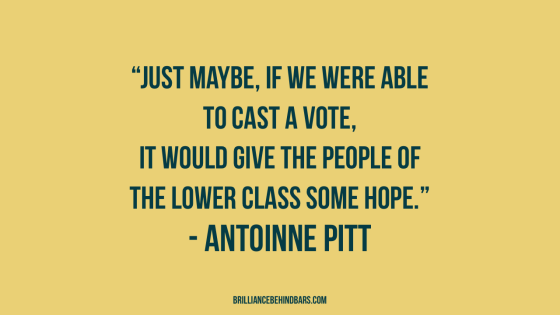
Just maybe, if we were able to cast a vote,
It would give the people of the lower class some hope.
Just maybe…

My name is Antoinne Pitt, I am from Portsmouth, Virginia, currently incarcerated at Lawrenceville Correctional Center. I am the author of Thinking With A Purpose, which is a curriculum created to reduce the rate of recidivism and prevent criminal thinking and influences and the author of C.O.A.T (Countering Overdoses and Addiction Treatment) a curriculum created to combat the opioid epidemic that has plagued our nation. You can contact my publisher, Winter Giovanni, for additional information or go to www.infinitypublicationsllc.net to see my bio. You can also support my fight for freedom by signing my change.org petition, or writing a support letter to: the Secretary Of Commonwealth, P.O. Box 2454 Richmond, VA 23218- 2454.

Peace and Blessings.

Prompt: The Incarcerated Vote

HR 1 is a voting rights bill that if it was passed in its original form, would have restored the rights of incarcerated people and ex-felons to vote in federal elections. The bill has long been amended solely to restoring the voting rights of ex-felons, but it also brought attention to another intriguing aspect I’m sure most people probably don’t know.

For centuries at the behest of the white establishment, minorities have been disproportionately policed, jailed, and imprisoned. Beyond stripping the lives away from young black and brown men in this country, states have found ways to actually profit from putting minorities in prison economically evidently, but more interesting, politically.

HR 1 identifies a law that allows counties with prisons to have people they house counted toward that county’s population on the U.S. census. Thereby pilfering the population of multicultural, urban (largely Democratic) areas and adding them to rural, largely white (largely Republican) areas. All the while, eviscerating the incarcerated person’s right to vote. This dynamic is the core of what can be considered as politically-motivated slavery.

With the reallocation of the urban populace to these rural areas, the voice of the people is stricken from a more accurate representation of the people, and is instead granted to a more diluted form of constituents who would be more likely in favor of continuing the trend of mass incarceration, post-millennium slavery, and the further exploition of black and brown people for personal and monetary gain.

HR 1 intends to correct that law and return the population of those incarcerated back to their hometowns… There has been much work in recent legislation concerning criminal justice reform to correct the racist systemic devices that have been used to disenfranchise droves of minorities in America for a majority of its history, however the threat of the old establishment looms over us all, impeding our progression to a more perfect union. Awareness is the first step, activism is the following one.

Know that the bile of racism runs deep, and its effects are subtle. The old guard feared that we, as a people, would become aware, so they withheld education and knowledge from us for centuries. But what they fear most is that, armed with such education and knowledge of self, we would actually do something about it, so they try to break and discourage us, and even pit us against one another. We must understand that we are solely responsible for making sure that their every effort from here on out is made in vain. Times ARE changing. We, at this moment, may not be able to enjoy a world truly free of systemic racism before our time is up, but be sure, our efforts now will be the catalyst for the world our future generations will experience…

I extend my love to each and everyone seeking freedom, not only for themselves, but the world now and the world to come…

Love, peace, and action…
-Q.

Prompt For Incarcerated People: Compose an essay, poem, art, or any other form of creative expression you may have. Think about your experience participating and learning about the political process. Below is a list of questions meant to serve as inspiration for your piece.

  • What is your experience with voting and the political system before and after incarceration?
  • What are your thoughts on voting while incarcerated?
  • How can we change the point of view on letting incarcerated people vote?
  • How has participating in the political system impacted your life?
  • Are you more educated about the system now than you were back then?
  • How would being able to vote change your life?

Make sure to let the people know who you are, where you’re from, and any project(s) you may have or have been involved with so we can promote it. Thank you for your contribution. We are working together to bring awareness to the brilliance they have locked away behind bars.

Thank you to the readers of BrillianceBehindBars.com. Answers to this prompt will be coming in through April of 2021 from those incarcerated across Virginia.

Future

“The future belongs to those who prepare for it today.” -Malcolm X

This quote just spoke to me as I read it this morning – because for millions behind the walls, their outlook of a future is bleak. Their daily view of life is bars, concrete and metal. Their days consist of daily counts, consumption of food not fit for humans, wearing the same orange/blue/brown jumpsuits (for the most case). I ask, how does one prepare for a future when they have no idea what the future holds for them? They were given decades long sentences and laws continue to overlook them because of their offense. They are deemed outcasts, a threat to society and threaten public safety. Some are innocent and punished for exercising their right to a fair trial. Others were teenagers, immature or dealing with mental illnesses and made a bad choice. How can they prepare for a future when they are not promised one outside the walls? How can your future belong to those who are prepared for it, when their future lies in the hands of legislators and lawmakers!

Over the last month and even some in 2020, I witnessed lawmakers and legislators sit in a box, debating the future of thousands of men and women behind the walls. Having intense discussions about their very livelihood as if they were discussing a non-existent thing that has no life. When they were discussing the fate of a human—a person that lives, breathes and who has the same red colored blood flowing through their bodies as them.  But they argued and determined that their lives do notmatter. They made decisions to kill bills that would allow those persons to come home to people that love them, children that miss them and spouses that bears the weight of life without them daily. These lawmakers and legislators do not know what it feels like to live this life every day because at the end of each day, when they are done making choices and decisions that keeps men/women behind the walls—they go home to their family, their children, and their spouses. They go home to family dinners and spend time tucking their children into bed each night. They sleep in a bed that is plush and comfortable. They have access to an unlimited supply of necessities. They do not worry whether they will wake up to see another day. 

These men and women still strive to have a positive outlook on life. They still strive to lay the foundation of a better future. They do not allow their current situations stop them from becoming a better person. They have owned their bad choice. They are not making excuses for what happened to them. Daily, they are growing, maturing, and changing the trajectory of their future. They have not allowed the obstacle of their path deter them from working towards their FUTURE!

In the words of our first black President: “Change will not come if we wait for some other person or some other time. We are the ones we have been waiting for. We are the change that we seek.” — Barack Obama

– Jerry James, Deerfield Correctional Center