An Idea for MORE Earned Credits

For a decade, I have been incarcerated. During that time I have greatly sought to become a better person. I have led church services and ministered to other inmates. I have taken college classes through International Christian College and Seminary. I have worked the various jobs I have been given and maintained employment during this time. I have taken rehabilitation classes as they have been made available to me. In fact, I have even taken “Thinking For A Change” multiple times because I volunteered to retake the class so the class would have enough people in it. I have taken no drugs or drank any mash. I have received no institutional infractions and have sought to be polite to staff, officers, administrators, and other inmates. And I have written a book that is in the process of being published. I do not write all of this to toot my own horn. I write this as a matter of fact, to prove my point.

Despite my being an example of a model inmate, I am in no way rewarded by the Commonwealth of Virginia for my good behavior and rehabilitative endeavors. I, like every other inmate in Virginia convicted of what the Commonwealth calls a violent crime, must spend 85% of my sentence in prison. So the question that has to be asked is, why should any inmate in a Virginia prison try to do things to better themselves? I mean, what is the point of doing something that has no reward associated with it? Think of it this way. If your boss told you tomorrow that he wanted you to start staying after work for an hour each day for a year so you could take a class to be a better employee, would you do it? And what if your boss told you there is no extra pay for taking the class or guarantee of a promotion? In addition, how would you feel about the class if you found out that other employees who aren’t taking the class aren’t suffering any consequences for not taking the class? Would you take the class to become a better employee for your employer if there was no reward for doing so? I seriously doubt it.

Anyone who has ever raised a child or a pet knows that punishment for wrongdoing and rewards for doing right must be doled out in appropriate proportion to one another. Let’s say you have a young dog that you want to train to be a good dog. And let’s say you begin by shocking the dog every time the dog does something wrong. You may cause the dog to stop some bad behaviors, but you will struggle to get the dog to behave correctly if you don’t reward the dog. So what do you do? You reward the dog for doing right and shock the dog for doing wrong. By doing this you show the dog that there are good consequences for acting appropriately and bad consequences for acting inappropriately. This seems like common sense, right? Then why don’t our state officials get it? Despite all of the right things I have done, I have to spend the same amount of time in prison as most violent offenders. And no matter how many right things I do, this fact won’t change. It is this fact that accounts for a great deal of the violence, chaos, drug use, and wrongdoing that is so prevalent in Virginia jails and prisons today. Why should inmates even seek to act in appropriate ways when they receive the same treatment as those who act inappropriately? Now someone may counter that by saying that inmates who act inappropriately won’t be released after doing only 85% of their time. That may sound good, but I see firsthand that it isn’t true. Everyday inmates who act inappropriately are released after doing 85% of their sentence. The Commonwealth’s system is severely flawed and in desperate need of an overhaul. Men and women who are incarcerated desperately need to be rewarded and punished proportionately in accordance to their behavior.

I have a suggestion that I believe, if made legislation, could greatly benefit inmates, the Department of Corrections, the Commonwealth, and all of society. I have suggested this to a couple of our legislators, but apparently it fell on deaf ears. Anyway, my suggestion is simple and provides incentives for inmates in Virginia to better themselves during their incarceration. It also holds Virginia inmates accountable for their right or wrong behaviors. Following the current sentencing guidelines, my suggestion is as follows: Inmates who obtain a degree, diploma, or vocational certification during their incarceration receive a 10% enhanced good time credit for each degree, diploma, or vocational certification they obtain. Nonviolent inmates may receive these enhanced good time credits up to the point of receiving 50% enhanced earned sentencing credits. Violent inmates may receive these enhanced good time credits up to the point of receiving 70% enhanced earned sentencing credits. However, these enhanced earned good time credits will only be made available to those inmates who remain free of institutional infractions, pass random drug tests, maintain employment, complete all required rehabilitative programs, and conduct themselves as model inmates. In this way inmates will be rewarded for appropriate conduct and disciplined for inappropriate conduct. Also inmates who work exceptionally hard to better themselves will be rewarded significantly for their hard work. In addition, the Department of Corrections will have fewer problems and the Commonwealth and society will reap the benefits of having men and women who leave prison smarter and better. These men and women will be more employable, more ready to start their own businesses, better equipped to integrate back into society, better equipped to become good parents, and much better equipped to become productive members of society. Isn’t that what we all want? Shouldn’t that be the goal of our criminal justice system, from start to finish? And shouldn’t our laws regarding sentencing reflect that?

Travis Sorrells, #1095956
Haynesville Correctional Center

A Message: Parole + Non-Violent/Violent

There is a lot of good that comes from what you are doing.

I wrote to the Richmond Times last week and spoke on the parole issue… I stated facts and can back it up… But it does no good unless everyone stands together… People want to go home, and I of all people respect that and I agree something needs to be done…

But everyone needs to understand that saying: ‘one crime is better than the other or one crime is violent and the other isn’t is wrong… Look, I’m involved in a start up program called Victim Impact: Listen and Learn. Its a straight forward concept that let’s real victims speak about what happened to them and what it does to them and their families… Not one said it didn’t do harm to them or their families. It is a fact that crime effects people in four main areas,: physical, emotional, financial, and spiritual… Some people has said they are locked up on non violent drug charges… Well let’s see here, the person dealing to people and getting them hooked on something that has them going out to steal, rob, or even murder a female priest for a confession plate just to be able to get the drug you got them hooked on… So the root of the evil was the person selling the drugs… Nonviolent overdoes?? Sorry but even stealing someone’s money without them knowing it causes harm regardless if you are there when it happens… We all need to do better in here and out there…

We all need to stop with, ‘I’m better than you’ crap, because that’s what is holding everything back… Illegal is illegal regardless… We want change from where we are at?? Then less start the change from within!!! Start with yourself, and with your partner and expand it out throughout the place you are at and then we will get the change we are looking for; because if we can’t change ourselves then those people out there are not going to want to help with our initial goals…

I just try to stay on point with what I’m trying to accomplish and I know its bigger than me… peace!!

Russell Browning

OPPOSING SCALES: THE WEIGHT OF VIRGINIA’S ENHANCED SENTENCE CREDITS & 2022 BUDGET AMENDMENT

By David Bomber

From the moment that Don Scott, Delegate for the 80th District of Virginia, introduced the Earned Sentence Credits bill in 2020, the atmosphere in this state changed. Suddenly, it seemed like criminal justice reform in Virginia was taking on real meaning, that change was finally coming about. In turn, this bill energized advocates and incarcerated folks alike, as well as their families, and further gave everyone involved a glimmer of hope. What fueled that fire even more was during that same year John Edwards, Senator for the 21st District of Virginia, introduced a bill to reinstate parole – an extraordinary measure considering that parole had been abolished in Virginia since July 1st, 1995. For all intents and purposes, it seemed like the lawmakers here in Virginia were finally getting it. Perhaps all the hard work that everyone had put in towards criminal justice reform was finally paying off.

Although the Earned Sentence Credits bill eventually passed, it turned out to only benefit some, while it dashed the hopes for many others. Initially the bill was introduced to provide incentives to gain an earlier release for any given prisoner who demonstrated good behavior and worked towards rehabilitating themselves. Unfortunately, that same bill was amended later on to exclude violations of certain offenses, such as malicious wounding, homicide, robbery, etc. This means that those affected by these exclusions can only earn the same rate of “good time” as they always have, a maximum of 4.5 sentence credits for each 30 days served (for those under the “new law”). The other crushing blow came that affected all the new law incarcerated folks as well as their families is when Edward’s bill to reinstate parole was first “tabled,” then eventually defeated. Perhaps lawmakers here in Virginia aren’t getting it after all – keeping folks locked up isn’t the answer. If anything it exacerbates the issue of mass incarceration.

What followed suit after that can only be characterized as mind boggling. In Governor Youngkin’s 2022 budget amendment, a provision was adopted that precluded anyone with “mixed charges” to benefit from the Earned Sentence Credits statue. In other words someone with convictions for something like grand larceny & malicious wounding doesn’t qualify for Earned Sentence Credits based solely on the malicious wounding. To put it fairly, this amounts than nothing more than a Draconian policy instituted by the Younkin administration. It is no wonder that the ACLU of Virginia has filed two separate lawsuits over these matters – one of which was recently won because the Earned Sentence Credits statue was misinterpreted and ultimately misapplied by the Virginia D.O.C. The other, which hasn’t been decided yet, addresses Youngkin’s policy on the ineligibility aspect of those with “mixed charges.”

If anyone isn’t surprised by these things, it is I. Convicted in 2011 of aggravated malicious wounding & second-degree murder, both the Court of Appeals and Supreme Court of Virginia’s determined that they could “not ascertain the legislative intent” and ultimately upheld my convictions – never mind that only ONE ACT was involved against the SAME VICTIM. From my perspective, it seems that Virginia has a track record of failing to interpret the statues properly, and further gives me the sense that I am being punished twice, unfairly I might add.

Similarly, the exclusions set forth in the Earned Sentence Credits & the 2022 Budget Amendment gives many incarcerated folks and their families a bleak outlook, particularly on criminal justice reform. As stressful and daunting as these matters are, now is not the time to roll over and pretend that these issues will go away on their own. The best thing that advocates, incarcerated folks, and their families can do to cope with these issues and bring about change is to take them on and get directly involved with Virginia’s lawmakers.

Thank you for taking time to read this. If you would like to get in contact with me directly, my contact info is enclosed below.

CONTACT INFO

To email me directly please visit http://www.jpay.com and submit Virginia ID #1130793 (Jpay is a service that the Virginia D.O.C. utilizes for prisoner communications with the public)(Note: this service does require users to purchase virtual stamps in order to send messages).

To follow my cause on Facebook:
@Justice4davidbomber

To join the conversation:
#freedavidbomber

To follow me on social media:
https://linktr.ee/freedavidbomber

For General Correspondence:
David Bomber #1130793
Nottoway Correctional Center
P.O. Box 488
Burkeville, Va. 23922

July Prompt: State Leaders, Mental Health, and Incarcerated Lives

It’s been an entire year since the VA governor’s 11th hour budget amendment that denied thousands of hopeful incarcerated people and their families long-awaited relief from Virginia’s harsh practice of over sentencing. The sudden walk back combined with the already adverse conditions (i.e. the Coronavirus Pandemic, Fentanyl, etc) plaguing the penitentiary have caused serious stress for some – myself included. This elevates the every day stressors of prison life from a common occurrence that can be remedied with moderate time and care, to a contest of will that can have lethal consequences for the defeated.

The prison yard has been relatively quiet, subdued by the jerk and pull of politics and the overwhelming sense of powerlessness. Dejected prisoners have not mustered the spirit to organize in light of all the work that has been done on their behalf in the past few years. From personal experience that spans a decade and a half, prisoners do not expect things to change and the past year has reinforced feelings of injustice. These feelings have been suppressed for the most part and redistributed to expressions that firmly place prisoners deeper into prison life and further from productive, prospective ways of thinking.

For me, the past year has been a crash course in environmental influence on mental health and how this is so essential to effective rehabilitation. It has also raised an important question in my mind: How much weight do our state leaders place on the mental wellness of its incarcerated? How much weight to they place on mental wellness and public safety?

State Democrats decided not to readdress Enhance Sentence Credits in this year’s General Assembly — predicting failure to pass and further unnecessary stress on prisoners and their families. Currently, the matter of Earned Sentence Credits and the Governor’s walk back of eligibility is being heard by the VA Supreme Court. This process can take quite some time to be decided. Other alternatives to relief include: expiration of the budget amendment in June 2024 (and hopefully its not reissued by the Governor and House), or The House gains enough Second Chance members in the upcoming election to push a bill through. This form of alternative also cannot be effective till 2024.

In the meantime, what do we do about the immense mental stress that is pushing prisoners to very bleak brinks — increased agitation, physical altercations, deep depression, and drug overdoses? Each of these issues have been exacerbated by Governor Youngkin’s political agenda and toying with human lives…

-Q, July 2023

Prompt Questions (Thought Starters for the Incarcerated Population):

  1. Can you identify any extra stress brought on by the governor’s budget amendment; for you, your environment, loved ones at home, or friends/family on the inside?
  2. How can the state better use resources in order to address the mental health of incarcerated people?
  3. What may be some key ways to deal with elevated stress while incarcerated?
  4. Can you think of any alternative ways the prison community can view the legislative process to better cope with changes like that of governor Youngkin’s budget amendment?
  5. What can we do as incarcerated people to ensure that we put the right people in office who care about our lives?

My American Citizenship

I want to touch on voting and on enhanced earned sentence reductions. The right to vote is fundamental to any civilized nation. As is the right to liberty, justice, and the pursuit of happiness. Should I, as an inmate and convicted felon, lose these things? No. It is true that I have lost a portion of my freedom, but only a portion. I am still covered by the Bill of Rights and the Constitutions of the United States of America and the Commonwealth of Virginia. I did not lose my American citizenship when I was convicted of my crime. I did not cease to be a resident in the Commonwealth of Virginia. So why should I, as an American citizen and a resident of the Commonwealth of Virginia, lose my right to vote just because I was convicted of a felony? The answer is simple, because it is a way to further punish me and because most Republicans believe allowing me to vote will cost them elections. Now that’s not how Conservatives will frame their argument against my right to vote of course. They will claim, with a very staunch look, that removing a convicted felon’s right to vote is a deterrent to crime. Honestly, though, have you ever heard anyone say they aren’t going to commit a felony because they will lose their right to vote? Nobody has. So here is the crux of my position on convicted felons, incarcerated or not, voting. If it is constitutional to take away the right to vote from an American citizen and a resident of the Commonwealth of Virginia because he or she committed a felony, then who is next? What’s to stop the government from taking away the right to vote from people who are pro choice? What’s to stop the government from taking away the right to vote from people who are Muslim? Now you are probably saying the Constitution stops them. Well, it didn’t stop them from taking away the right to vote from felons who are covered by the same Constitution of which you are speaking. Let me be fair though. I have been on both sides of the criminal justice system. I do fully understand stripping some rights away from convicted felons. I understand stripping a convicted felon of his or her right to bear arms. I understand stripping a convicted felon of some of his or her protections against searches and seizures. These things are done for the protection of society at large. But how is anyone protected by denying convicted felons the right to vote? They aren’t. That takes us back to my earlier point, denying convicted felons the right to vote is nothing more than further punishment. It is a Conservative stance to show that they are tough on crime and a product of their fear that allowing convicted felons to vote will cost them elections. However, I don’t think anyone believes it is constitutional to deny someone the right to vote just because they won’t vote the way you want them to. Yet that is what is happening to convicted felons each time we have an election.

Now to my second point, enhanced earned sentence reductions. These reductions make good sense on a number of levels. First, they make prisons safer for inmates, officers, and staff. The more an inmate has to lose, the more that inmate will think before doing something wrong. The less an inmate has to lose, the less that inmate will care about doing wrong. Second, giving an inmate the chance to earn credits toward a sentence reduction gives an inmate hope and something to work for. Hope and purpose are essential to anyone’s mental and physical wellbeing, especially an inmate’s. Now I realize that Departments of Correction do a great job of talking about rehabilitation, but that is basically all smoke and mirrors. The reality is that they do the absolute bare minimum to even try and rehabilitate anyone. That leaves rehabilitation in the hands of the inmate. He or she must take the initiative to better themselves. However, for most inmates that seems pointless. What is the point in trying to better yourself when you are not rewarded for it? Therefore, I have an idea I would like to see implemented in Virginia and other states as well. As the federal government makes pell grants more available, I believe this idea will become more and more implementable. Many inmates leaving prison are behind the eight ball educationally when they seek employment. I propose that states enact legislation that allows an inmate to earn enhanced sentence reductions for every degree the inmate receives while incarcerated. States could provide an inmate with a five percent reduction in their sentence for each degree they earn, on top of their good behavior reduction. This would make for smarter and more knowledgeable inmates. It would make for more qualified and employable men and women looking to join the workplace following prison. It would improve the mental and physical wellbeing of inmates. It would allow inmates a quicker transition back into society. It would allow inmates the opportunity to do something that would bring themselves, their families, and their loved ones a sense of pride and accomplishment. And it would keep inmates busy, leaving them less time to get into trouble. I firmly believe this program would benefit the States, the inmates, inmates’ families, employers, society, and our nation as a whole.

Travis Sorrells, Haynesville Correctional Center
BIO: Currently, I am about nine years into a fifteen year sentence. I am also seeking a Theological Degree through International Christian College and Seminary. My goal during this time is to make myself as ready as possible to reenter society in a way that allows me to be both productive and contributive.

A Letter From Jerry James to State Leaders

To The Senators and Delegates,

My name is Jerry L. James. I am a first-time offender who received 73 years with 35 years suspended, which left me with a 38-year sentence. As I sit here at Deerfield Correctional Center, 22 years later, I have done all I can to rehabilitate myself by completing mind-changing programs, as well as getting my G.E.D., plus enrolled myself into college to receive an Associate’s Degree in Biblical Studies.

I also remained charge-free for 17 years of the 22 years I’ve done already. I give all praises to God, who has given me the strength to hold on this long. Not knowing there wasn’t no parole for the new-law prisoners when I came in the system which make it very hard to know you have to do all your time unless you receive a pardon by the Governor. Which we know is like winning the Mega Millions – a slim shot to none.

When the the General Assembly voted and passed the enhanced earned sentence credit bill in 2020, which gives guys like myself a sense of hope for an opportunity to earn more good time to be able to go home a little earlier because we’re only getting 4.5 days a month of good time as I speak. But as we know, Governor Youngkin added a Budget Amendment that replaced the bill -which caused guys like myself to be exempt from getting something that we worked hard to get.

I had to tell my 71-year old father the bad news. He is still recovering from a stroke he had a few years back. I know I did wrong to get in here, but with 10 more years to do, please somebody have some type of compassion and give me a chance and the guys like myself, before our love ones will be no more.

l would like to thank you for this opportunity to share my thoughts with you. If you would like to contact me with feedback, questions, or just a conversation. Go to the app store, and download the JPay app, using my name and number to create an account to email me.

Jerry L. James
#1157844

Challenge

Hello my name is Leroy Williams, and I’ve been in prison since I was 18, now I’m 44 and I am not the same person I was when I was 18!! Not to make light of what I done to be in prison, but I am being punished for who I use to be, and not who I’ve become. Our current Governor made that crystal clear when he repealed the bill that would have allowed those that made the necessary to better themselves. It’s a challenge, but we must move forward with the same intensity that brought us this far. There’s an understanding that we want to make sure we do the right thing and not play politics with people lives.

Yes, I am very strong due to my faith. But for those that are not, I want to encourage them and believe that God is still working behind the scheme.

Your brother,
Leroy Williams
#1162777

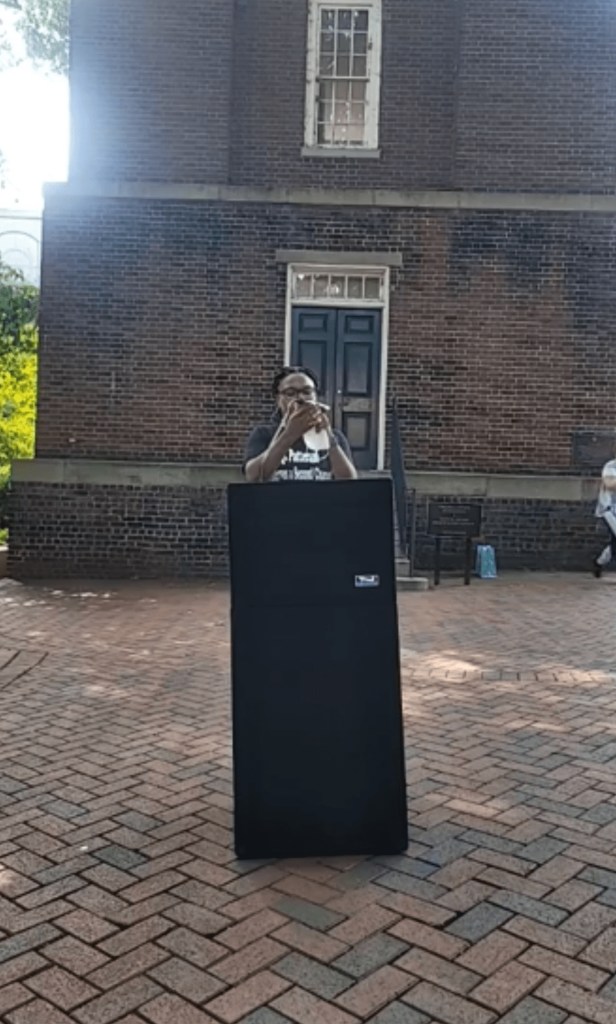
Speech by Q at the Rally Against Earned Sentence Credit Revocation

Listen as Q speaks at the rally about what it’s like to be incarcerated right now, and what it’s like to do too much time. He also addresses all of us out here and reminds us how much WE can take action and show up as families of the incarcerated. Thank you to Voice for the Voiceless, Humanization Project, Delegate Don Scott and others who were able to show support today. The work isn’t done!

Our editor, Santia, holds an iPhone to the microphone for the public to hear.

Too Much Time: July Prompt

It’s been about a month since Governor Youngkin dastardly used his power to amend the state’s budget and deny thousands of deserved inmates a chance at an earlier start on a new life in the free world…

Advocates have rallied in the name of those incarcerated. Media outlets have been taking notice. The time has come for us who are imprisoned to speak for ourselves… WE have a voice, and we have a platform. Brilliance Behind Bars belongs to us all. Let’s let the world know what goes on behind the walls – the things apathetic politicians deliberately hide from the public eye…

Write an essay, compose a poem, or just drop some quotes describing your personal struggles in the penitentiary for your own rehabilitation, and explain how the denial of justice has affected you and your family. Explain to the public, legislators, advocates, etc. why you deserve a shot at an earlier release date. Remember: the world is really taking notice now. Let your voices be heard!

Do not forget to include your name and any contact information for any readers who may be able to offer you some assistance.

I have more love than you can imagine for each and every one of my brothers and sisters on this side of the struggle. I pray we find the light in these dark times.

Sending love, blessing, strength, and hope,
-Q

Too Much Time: A Letter to the VA State Leaders about the Budget Amendment Rollback of Earned Sentence Credits

By Quadaire Patterson

I can say, with utmost certainty, that I have been in prison for TOO LONG. And the longer I stay, the harder it is for me to keep my spirits high, to give my all to the pursuit of ‘better,’ and to truly be the change I’ve become.

Despite the DOC’s egregious lack of true focus on rehabilitation, I know that I have made the most of my 14 years behind bars by leading my own journey to being the best version of myself. Day in and day out, waking up in prison slowly gnaws away at the intensity of that inspiration and stifled MY momentum… but never totally extinguished it.

I plea with Virginia state leaders to save my spirit and others like it, as time in prison can be just as destructive to a person, as it can be in rehabilitating them. It is true, time heals all wounds; but too much time begins to erode even the greatest of monuments.

My story isn’t one you hear often when thinking about the concept of prison – but its more common than you may think. Not once have I ever taken my incarceration, nor my rehabilitation, lightly. I always took the experience as an opportunity to grow and change my life around. From the onset of jail, before reaching prison, I worked tirelessly to build practice in meditation and spiritual strength, and gain purpose behind my life. Not once have I ever denied myself the responsibility of my own actions or felt as if I didn’t deserve to be in here. I chose books instead of card games, I chose to watch news programs instead of entertainment. At times, I even accepted that I wasn’t ready to return to society just yet. I used to say to myself, “even if they came to let me out today, I wouldn’t be ready.”

I’ve faced challenges along the way, as I haven’t always made the right choices. But still, I kept my head above the fray and the thick air of desperation and destitution that fills the penitentiary from wall-to-wall. I can recall great moments of inspiration, where I was more than ready to face the world with new eyes and put forth my newfound perspective toward the mission of making a better tomorrow… these moments began in the year of 2012, 4 years into my 20-year prison sentence.

I have never once sought my rehabilitation with the motive of early release. I’ve undertook every means of my own rehabilitation, purely because I would inevitably be released and finally got serious about my own life. Still, I continue to maintain the vision of a new day of freedom for me and to maintain a version of a future in my heart where I can use my past to help guide others with the guidance I needed as a child. I just figured the leadership finally recognized people like me when they passed the expanded earned sentence credits in 2020.

Maybe that’s why it hurts me so much to hear that people don’t believe I deserve a chance at earning an earlier release date. I’ve put faith in the system – even when it was hard to – and even when it imprisoned me. I sought to understand it, and in return, it has not reciprocated the same sentiment. The system has not sought to understand me as a person; to understand that against the odds of incarceration, I’ve still maintained my hope and faith in society regardless of what it has done to me.

Yes, I had to come to prison to find myself, but I am absolutely sure that I don’t have to STAY in prison to keep it. As a matter of fact, I feel a tiny piece of my spirit gets chipped away every time I hear another person has overdosed, or got into a fight, or stabbed. Every time, I lose a little more faith in the system, another fragment of my vision of a new day…

I know WAS a misguided young man, and in the process of being so, I may have caused harm to some people over a decade ago. I’m not making excuses and not saying that the pain of the people I hurt was not important. What I am saying is, I’m a new person, and I deserve a chance at being proactive with my change and begin to make amends sooner than later. The person I am now will NEVER revert to crime. The person I am now, at 34 years-old, understands his own potential: an understanding that isn’t afforded to a lot of poor, black youth.

I ask state leaders to not disregard my efforts, or others like me with a self-imposed rehabilitation and personal growth, by saying it is unworthy of actual redemption in the form of an earlier release date. When you disregard us, now it is YOU who are working against a greater version of what we are today.

-Q. Patterson, Brilliance Behind Bars Creator