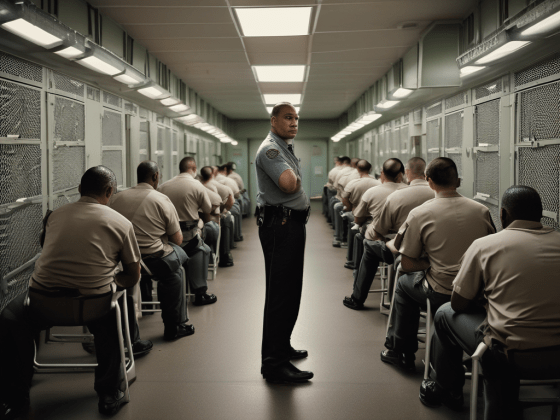
Why does the Shortage of Correctional Officers exist?

In order to understand the effects that the shortage of Correctional Officers is having on the life of the imprisoned, we must first understand: why does the shortage of Correctional Officers exist?

Wherein, lies the rub:
Obviously, there has been a paradigm shift in the collective consciousness of America, when it comes to accepting employment as a Correctional Officers: and paradigm shifts’ are no more than the mind -by way of- the conscience, evolving from one moral stage to the next. Therefore, it appears that the “amoral” lifestyle of a Correctional Officer, stands in Stark Contrast to the moral and ethical growth and development of this conscious oriented America we find ourselves living in these days – for, not only doe’s such a career choice leave’s the mind and consciousness stained with unfavorable memories ( i.e. PTSD ) but, for those who relegates’ themselves to the retirement line, more often than not they find themselves searching for another job, just to make end’s meet, therefore, I surmise low wage’s can also be a contributing factor.

Anyway, the question becomes:
How do the lack of moral consciousness within the staff, rather short or full, effect the prisoner therein? Well, it’s akin to the blind leading the blind, for, how can a Correctional Officer teach or learn an inmate what they don’t know and vice versa: therefore, when I hear inmates mimicking the shortage of Staff, effects; the freedoms and liberties within the prison, such as; Visitation, Recreation, Vocational Programs……. etc. I just mentally shake my head in silence, because, these are the obvious tears of the blind, who, can’t see pass their own incompetence, thereby, trying to appear intelligent in their mimicking of the aforesaid.

And, as not to be misunderstood, I’m not advocating anti-social behavior when it comes to taking advantage of said freedoms and liberties within the prison: Quite the contrary, for, by all means please amass all of the trades and programs….. etc. that you can amass, for, these are the fundamental accomplishments that you don’t want to be a hindrance when it comes time to go home.

However, and at the same time I’m also trying to impart to the Inmates, DOC can’t teach you how to become a man, therefore, please stop waiting on teaching/instructions on how to become a man, especially from a person whom has never seen or looked upon you as a man. Look, I am a staunch believer in self-reliance and Self-discipline and that through such attributes, he who apply themselves can accomplish anything (within reason) that they set their mind to. Therefore, irrespective of the number of officers or staff, the direction of ones choices ultimately rest upon the individual, as it pertains to what you are trying to contribute to this life, because, it is absolutely through what you put into this life that will determine how life responds to you.
Therefore, in addition to amassing said fundamental accomplishments, you must learn to continue to educate yourself beyond your own expectations. (autodidact). Because, it is 99.9% likely more than not, that the job you secure upon your release will not have any resemblance to your fundamental prison accomplishments.

And just one more philosophical thing to add to your studies:
Pay attention to that inner voice of consciousness, for, the best teacher is within, with the understanding that the knowledge imparted therefrom, is also being imparted to other students of the like. therefore consciousness is sharing and sharing is consciousness.

In closing and from an analytical perspective, I would just like to add:
The life of a Correctional officer has been devolving into this stage of decadence for a minute now – and now the powers that be are desperately searching for a panacea to a problem that they have – (through perpetual greed) – created upon themselves, which, they are not now understanding, that as the prisons continue to evolve, the algorithm seed of greed and hate has taking on a life of it’s own, thereby, in it’s wake creating a prison environment that has never been needed for breaking the hardest of the hardest, and thereby, slowly and silently absorbing any attractive features of incentives that, at one time may have possessed the job of a Correctional Officer, prior to this critical stage of decadence said job now finds its self in.
However, it appears DOC., is of the erroneous opinion of, thinking that the hiring of poor English speaking people from oppressed geographical locations around the globe is the answer: and nothing can be further away from the truth, for, quite the contrary, this quick fix hiring scheme is only going to exacerbate -(if not already)- the future of decadence – for – the conscience has no choice but to be true to itself, therefore, the question of morality becomes: how do one whom is running from being oppressed; reconcile becoming the oppressor?

And please let it be understood: he who lives contrary to the truth inexorably becomes a cynic.
As not to let this analytical interpretation on behalf of DOC take away from the topic of discussion, I’ll share the following advice with DOC: Employ more classes on human-relations for staff and try treating all people with a little more of humanity and kindness, also revisit your Correctional Officer and Inmate Pay scale’s with a little more of everything, thereby, marketing your brand in accordance therewith.

And to my fellow inmates, make sure its top notch, cream of the crop, because, this is how BBB Rock.

A. Cameron(# 1172733)
Beaumont Correction Center

A Solution: Body Cams

“What can we do as incarcerated people to ensure that we put the right people in office who care about our lives”?

Well, first of all, we need to tell all our friends and love ones on the outside to vote this year for candidates who are supporting “Second Chance.” Also, for candidates who are willing to push for a new “MANDATORY” legislative law… requiring that [all] Virginia Department of Corrections (VADOC) officials (Wardens, Majors, Unit Managers, Captains, Lieutenants, and Subordinates) to wear “body cam”, and for it to be kelp on at [all] times when enter acting with inmates. This will ensure there’s no misunderstanding as to what was said between the VADOC officials and inmates. The lack of “body cams” have clearly caused major problems within the VADOC…because most investigations end up “UNFOUNDED, due to lack of evidence. These problems could have been avoided years ago…if “body cams” were issued to every VADOC official. We need candidates who will step up and fight for the rights of incarcerated individuals. Look at the life’s that have been lost in the VADOC due to violence. We need everyone to get out there during voting time and vote for candidates who’s will to serve and protect those who are housed within the VADOC. We need everyone to get on board! Please do this for your love ones…because they need you. The time is now!!!

Secondly, we have to be proactive ourselves, and write to those candidates as well. When writing to such candidates, please be respectful and explain to them your thoughts and concerns.

Thank you,

Curtis L. Floyd, #1036136

OPPOSING SCALES: THE WEIGHT OF VIRGINIA’S ENHANCED SENTENCE CREDITS & 2022 BUDGET AMENDMENT

By David Bomber

From the moment that Don Scott, Delegate for the 80th District of Virginia, introduced the Earned Sentence Credits bill in 2020, the atmosphere in this state changed. Suddenly, it seemed like criminal justice reform in Virginia was taking on real meaning, that change was finally coming about. In turn, this bill energized advocates and incarcerated folks alike, as well as their families, and further gave everyone involved a glimmer of hope. What fueled that fire even more was during that same year John Edwards, Senator for the 21st District of Virginia, introduced a bill to reinstate parole – an extraordinary measure considering that parole had been abolished in Virginia since July 1st, 1995. For all intents and purposes, it seemed like the lawmakers here in Virginia were finally getting it. Perhaps all the hard work that everyone had put in towards criminal justice reform was finally paying off.

Although the Earned Sentence Credits bill eventually passed, it turned out to only benefit some, while it dashed the hopes for many others. Initially the bill was introduced to provide incentives to gain an earlier release for any given prisoner who demonstrated good behavior and worked towards rehabilitating themselves. Unfortunately, that same bill was amended later on to exclude violations of certain offenses, such as malicious wounding, homicide, robbery, etc. This means that those affected by these exclusions can only earn the same rate of “good time” as they always have, a maximum of 4.5 sentence credits for each 30 days served (for those under the “new law”). The other crushing blow came that affected all the new law incarcerated folks as well as their families is when Edward’s bill to reinstate parole was first “tabled,” then eventually defeated. Perhaps lawmakers here in Virginia aren’t getting it after all – keeping folks locked up isn’t the answer. If anything it exacerbates the issue of mass incarceration.

What followed suit after that can only be characterized as mind boggling. In Governor Youngkin’s 2022 budget amendment, a provision was adopted that precluded anyone with “mixed charges” to benefit from the Earned Sentence Credits statue. In other words someone with convictions for something like grand larceny & malicious wounding doesn’t qualify for Earned Sentence Credits based solely on the malicious wounding. To put it fairly, this amounts than nothing more than a Draconian policy instituted by the Younkin administration. It is no wonder that the ACLU of Virginia has filed two separate lawsuits over these matters – one of which was recently won because the Earned Sentence Credits statue was misinterpreted and ultimately misapplied by the Virginia D.O.C. The other, which hasn’t been decided yet, addresses Youngkin’s policy on the ineligibility aspect of those with “mixed charges.”

If anyone isn’t surprised by these things, it is I. Convicted in 2011 of aggravated malicious wounding & second-degree murder, both the Court of Appeals and Supreme Court of Virginia’s determined that they could “not ascertain the legislative intent” and ultimately upheld my convictions – never mind that only ONE ACT was involved against the SAME VICTIM. From my perspective, it seems that Virginia has a track record of failing to interpret the statues properly, and further gives me the sense that I am being punished twice, unfairly I might add.

Similarly, the exclusions set forth in the Earned Sentence Credits & the 2022 Budget Amendment gives many incarcerated folks and their families a bleak outlook, particularly on criminal justice reform. As stressful and daunting as these matters are, now is not the time to roll over and pretend that these issues will go away on their own. The best thing that advocates, incarcerated folks, and their families can do to cope with these issues and bring about change is to take them on and get directly involved with Virginia’s lawmakers.

Thank you for taking time to read this. If you would like to get in contact with me directly, my contact info is enclosed below.

CONTACT INFO

To email me directly please visit http://www.jpay.com and submit Virginia ID #1130793 (Jpay is a service that the Virginia D.O.C. utilizes for prisoner communications with the public)(Note: this service does require users to purchase virtual stamps in order to send messages).

To follow my cause on Facebook:
@Justice4davidbomber

To join the conversation:
#freedavidbomber

To follow me on social media:
https://linktr.ee/freedavidbomber

For General Correspondence:
David Bomber #1130793
Nottoway Correctional Center
P.O. Box 488
Burkeville, Va. 23922

What’s a Pound of Human Worth?

By Christopher Smith Read

The institution of slavery is still alive and well in these United States. For authority, I cite the U.S. Constitution, Amendment XIII: “Neither slavery nor involuntary servitude, except as punishment for a crime whereof the party shall have been duly convicted, shall exist within the United States, or any place subject to their jurisdiction.” Readers doubting the actual effect this has on the twenty-first century, consider this: the author, as a person “duly convicted” of a crime, is required to work for the Virginia Department of Corrections, as a condition of his good time earning allowance, and is paid 45 cents per hour. Minimum wage laws do not apply to slaves. If he doesn’t work, then the department, through its own legislatively delegated authority, can make him serve his entire 10 year sentence.

This is the reality for millions of men and women throughout this putatively liberty-loving country; a country which, with proper historical, economic, and political context, has zero choice to be what it is: the world leader for keeping people in bondage. Granted, many countries subject prisoners to far more barbaric forms of imprisonment, but the U.S. nevertheless stands quite alone when it comes to the sheer scale of its operations. And United States’ prisons are barbaric for a far more insidious reason: U.S. prisons impose a strict regimen of pure, profit-driven apathy.

How we got to this point is no mystery. In fact, we’ve been doing things this way for so long that even before 1776, when we declared ourselves independent, the stage was set for today. As I’ll argue, we have no choice in the matter; structurally, the U.S. was destined to commoditize human flesh. And only through wholesale, aggressive federal legislation – or better yet, Constitutional amendment – will this ever change. But this analysis will end with what the author sees as a naively Panglossian prescription, given the alignment of the current interests in this country. That said, as Red, played by Morgan Freeman, concedes over and over again in “Shawshank Redemption” : “Hope is a dangerous thing. Hope can drive a man insane.”

Over three centuries ago, in 1714, a transplant from Rotterdam settled into London and penned this scandalous poem:
“Millions endeavor to supply
Each others Lust and Vanity…
Thus every Part was full of Vice,
Yet the whole Mass a Paradise.”

Bernard de Mandeville (1670-1733), laid down the claim that “private vices are public virtues” in his “Fable of the Bees”, a sentiment not denied by the Father of Capitalism, Adam Smith (1723-1780), but put forth in his “Wealth of Nations”, with far more sensitivity to the era’s puritanical sensibilities than Mandeville could muster. Even still, both men had identified the beating heart of today’s free market, capitalist economies: people responding to incentives, exploiting opportunities with no regard for society’s well-being, and yet through their consumption, benefitting us all nonetheless.

And there is no doubt in anyone’s mind that capitalism generates wealth. Nor is there any real argument to be had that capitalism’s nearest competitors can even contend. They can’t. But, as with all things, there is a tradeoff; or, as economist’s call it, an opportunity cost. For to make a few immensely wealthy, and most historically far more comfortable than their ancestors, millions will find themselves locked in cages for profit. In a cruel twist, then, many victims of their of own vice, no doubt, will be locked away for public benefit – bees who can never come back to the hive.

Economies are circular networks; one person’s spending is another person’s income. Thus pretty much every tax dollar spent on incarceration ends up back into the hands of private enterprise. The concrete and fence contractors providing the means of bondage, the massive food distributors responsible for providing prisoners with the sustenance – just barely; even the army of correctional officers’ paychecks – all of this eventually worms its way back into private hands, private hands which constitute an asset holding class of people, U.S. citizen or not.

The asset holding class – or Marx’s capitalists – generally do not vote against their own interest. And they generally have an outsize influence on politics, being the people most likely to donate to politicians who will vouchsafe their wealth on the floors of this country’s legislative bodies.

And running prisons says nothing of the mega corporations existing in a symbiotic relationship with the state. Keefe Commissary Group, GTL, Bob Barker Corp., Armor Correctional Health, these are just a few named familiar to nearly every modern prisoner. Mega corporations such as these shamelessly gouge prisoners and their families, all with the blessing of the state in which they operate.

Yet, who can really blame the institutions and firms involved? Where’s the incentive not to seek profit from what lawbreakers have done to wrong society? If the state is to tax its citizens for arresting, prosecuting, and punishing those who harm society, then what’s wrong with getting tax payers the most utility for their dollar? In theory, if private enterprise, contracted to do what the state’s duty is, insofar as incarceration is concerned, can offset – or net out – the cost of its prisons, then society benefits; teleologically, this all sounds good and well. And the father of utilitarianism, Jeremy Bentham (1748-1832), had exactly this in mind with his Panopticon, which, interestingly enough, Parliament shot down because they feared the corruptive effects private enterprises would have on the lives of the Kingdom’s prisoners. One today cannot avoid the feeling that this presumption was particularly prescient.

Britain’s Parliament was right to be suspicious. The problem with this utilitarian line of thinking is its paradoxically antithetical quality in light of the very idea – the central focus – of this country’s founding: liberty. How ironic the country oppressing us saw this yet we didn’t. And still don’t.

To see the root issue here we again turn to the Constitution. Fully four of the first ten amendments to the U.S. Constitution are intended to protect those accused and convicted of crimes. As much as liberty is explicitly revered in our founding document, the implicit reverence is no less apparent. Which is why, structurally, our free-market economy, with its incentives to commoditize people, is inherently at odds with what we hold most dear: freedom. Simply put, where there exists any incentive at all of the monetary sort to put people in bondage, then the interests of liberty and capitalism clash.

Capitalism, however, cannot be cast off. It works too well. It creates too high a standard of living for far too many to replace with something untested. Though that does not imply market should run unfettered; that’s exactly why people are overly incarcerated today. Rather, the seemingly impossible task is to remind the people that liberty trumps profit, insofar as punishment is concerned.

Thus the author envisions a realignment of priorities, eschewing, by legislation, the incentives so at odds with liberty. In order to radically change the structure of our economy, to reduce the suffering of over incarceration – and ineffective incarceration – we must ensure the state and its private partners have zero monetary incentive to engage in such conflict-prone, deleterious practices in the first place. Positive policy changes will mean society actually pays for incarceration, and that the only real return is of people who’ve been truly rehabilitated. Thus the incentive must be for society to actually invest in those who run afoul of the law. Manufacturing need only perpetuates the problem.

When society actually pays for incarceration, then society will be incentivized to invest properly in the prophylactics to crime: education, vocational training, substances abuse counseling, and diversionary programs in lieu of incarceration. We do these things now, but they are lacking in efficiency and effectiveness.

This all skews left on the political spectrum, yet it’s far more than a matter of politics. But must we as a society simply box ourselves into the tribalistic corners from where we feel comfortable? Why can’t we dialogue, mutually engage, and share in diagnosing what’s wanting in society, without being beholden to some homogeneous theory of political and economic function?

The reality is that the incentive exists for the state to incarcerate any of us at any time because a whole industry – and wealth – has been erected on top of liberty. Society must have prisons. But society shouldn’t let that need drift into the realm of liberty. Until this incentive is removed, the over-incarceration will continue. We have no choice in the matter.

Christopher Smith Read #1770228
Haynesville Correctional Center
Haynesville, VA