The Nation’s Correctional Staffing Crisis: The Toll on Incarcerated People

Recently, the editor of Brilliance Behind Bars was called before the U.S. Senate to give testimony on the understaffing crisis effecting prisons nationwide. She represented our interests with great compassion and much needed perspective. It is now our turn to support her efforts with our own experiences and insights. Let’s allow the public a real glimpse into our struggle as incarcerated people living in a prison understaffed…

For decades, prison has been held as an institution designed to mete out punishment to “evil-doers.” As time has progressed, so too did the caricature of the inhuman prisoner within the social conscience of the public. This depiction has led to a dangerous lack of concern for prisoner security, treatment, and adequate staffing to conduct daily, essential operations.

In the wake of the Coronavirus Pandemic, no areas of industry was left unscathed by understaffing issues. But there is a stark difference between the need for fast food service workers to tighten up lapses between combo meals served to various customers and the need for correctional staff to maintain the order and operation of a coercive institution and its hundreds of long-term residents.

Correctional facilities are more akin to state hospital and nursing homes fundamentally, being that its residents are forced to stay in such facilities. Residents of these type of facilities are solely dependent on the facility to provide critical medical care and treatment programs designed to aid in social and psychological health and development.

Given that prisons are institutions filled with residents living in close quarter communities, lack of proper staff often leaves responsibilities of security and treatment to fall to the hands of other prisoners. I, myself, have even had to serve as an interim first responder during medical emergencies involving other incarcerated. Ironically, the institution has enacted policies to deter the incarcerated from lending aid to others, but have yet to solve the very real crisis of understaffing in prisons in this state and nationwide. Also worthy of recognition is the incarcerated community’s drive to create treatment programs amongst themselves in spite of the lack thereof provided by the facility.

It is well documented that some private corporations have exploited the widely accepted practice of understaffing prisons in order to increase their profit margins. Although, we cannot exclude the fact that this was made possible by governments diverting interest in funding prisons as institutions of rehabilitation, and opting to view prisons as human warehouses for the disadvantaged. This is a framing that is more favorable to the rhetoric on the economic benefit than actual social benefit. Also, it’s no secret that working in a prison isn’t the most desirable work environment.

2020 did not cause prisons to be dangerously understaffed. 2020 only unveiled a deep-rooted practice that has been the void of compassion for human life for over 25 years in the making. The current state of prisons in America are echoes of the prison ‘reforms’ of ’95. Thirty years later, we clearly see the product of debased political agendas and public susceptibility to crime-based propaganda. That is, mass incarceration, a nationwide prison understaffing crisis, and instability socially and economically.

Note: I do not wish to end this writing without stating how very proud I am of each and every one of the incarcerated who have utilized their time and effort seeking not only the rehabilitation of themselves, but also that of their fellow incarcerated. Each member of the incarcerated population was forced into this situation and have so much stacked up against them, but these individuals have maintained the strength in spirit and the depth of human will that is undeniably world-changing. I pray that each one of you find your freedom physically one day, because you have already achieved a level of freedom mentally that few will ever experience.

Your spirit is tried and your spirit is, without a shadow of a doubt, TRUE. You are the torchbearers–your light leads the way through some of the thickest darkness known to the civilized world…

Love and Peace,
Q

Prompt: As mentioned above, we want to know about your experiences. Feel free to free-write, or to use the thought starter questions below:
1. How has short staffing affected your livelihood as an incarcerated individual?
2. What do you think is the cause of understaffing of prisons nationwide?
3. Are there any highlights of positivity that you have witnessed during your incarceration in regards to staffing?

How Can State Leaders Address Substance Abuse in Prison?

I’d like to reply to one of the questions you asked in the last prompt, which was: “What do you think the prime agents are that contribute to substance abuse in prison? And how can state leaders address this problem?”

Well, I think the prime agents that contribute to substance abuse in prison is the lack of prison officials and staff personnel in evaluating those individual inmates who have issues of substance abuse and/or have issues with abusing their current medications. They’re the individuals who need to attend substance abuse, not the inmates with no issues of substance abuse. Staff constantly force inmates into programs that they do not need. This is being done so they can receive federal funds for those type programs but everyone doesn’t need that particular type of program. Yet, staff personnel’s refuse to enroll those individual inmates— who actually need such programs and rehabilitation— should be held accountable for not doing their jobs in making sure that those individual inmates receive adequate treatment in appropriate programs while incarcerated.

Plus, staff claimed that inmates were bringing in the drugs through the visiting room…yet, when contact visitation was taken away the drugs were still coming in. Here recently, staff claims that the drugs are coming in through mail, magazines, and book orders…but, that has been proving to be a lie too. So, it can’t be the inmates that are bring in the drugs because all the ways they may have had in doing so has been stopped…yet, drugs are still coming in. So, how are they coming in? Its not hard to figure out! Everything that is sent in to inmates is thoroughly inspected, searched, scanned, and sniffed out by dogs, etc..

As to how state leaders can address this problem? Well, they can start by making it “Mandatory” for all individuals with issues of substance abuse and/or abuse of taking medication prior to incarceration, and during their term of incarceration. This would allow those individual inmates to get the adequate treatment they need before being released back into society…in doing so, they will have a better chance of getting out and staying out. As long as prison officials and staff personnel continues to allowing these type of inmates to keep on abusing their medications, and allowing them to continue to refuse such programs… then, this issue will continue to be a major issue in the future. State leaders need to address these issues immediately! For lives are being lost, and as of this day, nothing is being done to fix the broken system. Prisons are used to rehabilitate individuals through incarceration, not to punish them further by turning their backs on those individual inmates who needs help.

Thank you,

Curtis L. Floyd, #1036136
Red Onion State Prison
P.O. Box 1900
Pound, VA. 24279
Email: http://www.JPay.com

Mental Health, Hopelessness, Depression, and Despair: You Are Not the Sin.

MENTAL HEALTH IS THE TOPIC,
NOW ALLOW ME TO ROCK IT.

Mental Health, Hopelessness, Depression and Despair, you are not the sin,
You are sometimes just misunderstood on your acceptance as a friend.
Mental Health is a friend and guide to help you heal inside,
She’s not evil’s prize come to take you to the other side.
Relax’s and understand Hopelessness is just a distant relative of despair,
Introducing you to hard times, so you can find out who you are.
Depression is no more than an emotion trapped inside of an illusion,
Expressing an array of feelings while searching for a conclusion.
But first things first, allow me to introduce Myself,
My name is “Alexander Cameron,” and of course you are Mental Health,
My vernacular is very sharp and cunning, How about yourself?
Mental Telepathy is how I roll, I think y’all call it Top Shelf!
Well, Mr. Top Shelf, Gun Violence has you labeled as a crisis,
Pay attention my son, its called politicians making sacrifices,
Y’all call it splitting hairs, we call it word splices,
You know, that lip service, that has you and yours on drugs and reaching for vices.
Check it: Japan say Guns on the streets are just simply dumb,
Her deaths through gun violence in 2022 is absolutely none,
Now, America, you know you are just too through,
Death’s through gun violence has you at Four Hundred Fifty Thousands in the year 2022.
America’s relationship with Mental Health knows no truth,
Mental Health, you are expendable and less than an excuse,
At lease there’s a silver lining, you are not responsible for the youth,
Who has their parents turning back the clock, looking for a clue,
To free their kid’s from this paranoid maze of deceit,
That has their minds trapped in what appears to be certain defeat;
Listen Children;
Your problems are yours to confront, but first you must understand,
No life is without problems, they go hand in hand.
Ultimately your problems are yours to face and yours to Solve,
Excuses are for cowards, get yourself Involved.
Some problems are easy peesy and some are very
hard,
but, its only when you try solving them, that you can tell yourself Good Job.
So, America, let us all give Mental Health her due: because;
No one is responsible for your happiness but you and only you.

Submitted By:

Alexander Cameron
# 1172733

Beaumont Correctional Center
3500 Beaumont Road
Beaumont, Virginia 23014

“What’s in the Box!?”

A Perspective on Trauma CompartMENTALization v/s Processing While Incarcerated
DOUGLAS V. JOHNSON, II (RNCC, #1937011)

We stare down into the seemingly bottomless & packed “box” suppressed with our demons/issues/insecurities/trauma. Not getting overwhelmed can be a tremendous task in itself… It can definitely lead to some significant procrastination… A fear of stirring up old pain can cause us to put it off until later as we find something sweet to keep us occupied/distracted.

Unpacking this box alone is not recommended because things usually get worse, before they get better… Unfortunately, in incarcerated settings, mental health resources/programs are severely limited/scarce. If we were in society, we could get a dedicated counselor/therapist to help us unpack this box…

Prior to my incarceration, I ran from working on myself for so long, but now I only wish I had a professional to take me through the process of processing it all. I just poured Gin & Jen on the box and lit it on fire, only to wake up the next morning with it weighing heavily upon my chest… I stored that old beat-up&tattered box in the back of the garage. I got tired of seeing that worn-out taped-up box, so I put it in the Fu€#!ng basement, & then the attic.

But, sitting with me in solitary confinement, I was alone with the box for two consecutive years… Emotions intensified to the n’th degree. The first piece of advice I got from my Boss/Colleague/Mentor was “A counselor just helps you understand yourself better and will give you tools to cope with your issues… So now, it will be on you to gain a greater sense of self-awareness which includes acknowledging your pain & demons… Begin to WRITE & Read, and Keep WRITING and Reading!”

Anyhow, the box gets lighter as we take our time to inventory its contents and acknowledge what’s in there… then, one by one we take it apart to process it, and then put each item on the damn shelf as if it were a trophy, somehow turning it into a Positive. Transforming the gruesome pain into Greater Purpose!!!… Then, we decide when to take the next item out of the box…

As I now confidently look my shelf of sculptures in the eye, I feel tremendous clarity of my issues. I have now taken my POWER back from the box. As the box got lighter, I began to understand myself so much better… A fresh perspective and outlook on life.

Something else also happened… My inability to concentrate began to dissipate and my reading comprehension and memory began to improve. I then realized the impact that my unprocessed trauma had on me over the years.

In our incarcerated settings, the lack of mental health services can exacerbate our mental health issues. Many of us turn to self-medicating our issues which worsens our situations. If we really want to honestly address our problems, we HAVE TO take the initiative to educate ourselves, better understand ourselves/issues, utilize any & all available resources, and invest in & cultivate our support systems. We CANNOT stop at “well, there are no mental health services.” If we wait on DOC (regardless of the state) to provide more services without taking personal accountability & initiative, then we are wasting our ‘Time.’

With all of the reading/writing/self-reflection, my communications skills also significantly improved… All of these improvements have led to me making HEALTHIER life-altering decisions and helped ensure I was emotionally available for my Family.

Addressing our suppressed mental health issues requires extremely hard work when we are out there in a free society even with an abundant amount of resources (therapists/counselors, support groups, variety of medication, treatment methods, etc.). While incarcerated, we have to work infinitely harder if we want to grow and build. One advantage that we do have on this side of the wall is, our ‘Time’ to get laser-focused on unpacking that box… With acknowledgement, comes growth…

-DOUGLAS V. JOHNSON, II (RNCC, #1937011)
19JUL23

Hear My Voice!

Hear my voice! Hear my voice!

Is there anyone out there? If so please listen to my voice. I was given a 38 year sentence. Is anyone out there that has a heart? Please take a moment and ” Hear my voice .” I have served 23 years of it so far. I did commit a crime and yes deserve to be punished, but not for this long.
There was a question asked if I can identify with the extra stress brought on by the budget amendment for me, my environment, my loved ones and prisoners behind the walls. My answer would be “yes.” Do you hear my voice crying out in the wilderness? We have a Crisis on Mental Health in the world today. Sad to say not just in our Society, but also behind the walls of prison as well. Hear my voice! Some of us can identify and some of us don’t know how to identify with the situation of it because we have been in denial for far too long. Hear my voice!

Before my incarceration I attempted suicide not knowing how to deal with depression. I know 23 years ago in the black communities we kept things like that on a hush-hush. We were taught to be strong and yet stay silent. Looking back almost two and a half decades ago if I would have gotten help – I believe I would not be in prison still, 23 years later.

Do you hear my voice! People that have a mental condition are being locked up for decades at a time not getting the help that they need. It seems as if they just keep you suppressed with medication after medication. What do we do? We take the medicine just to get by. I believe D.O.C. really needs Mental Health programs that would help people deal with their problems head on instead of just coping with it.

Hear my voice! Hear my voice! I’m still holding on as best as I know how. I must say prison can really work on your Psyche. Especially being incarcerated decades after decades not being able to go up for parole or even have a chance to receive Earned Sentence Credit’s which I have earned my rights to receive. Having done all I can to rehabilitate myself by completing mind changing programs offered by D.O.C. as well as getting my G.E.D. in 2013. I have also been charge free for 18 years of 23 years of my incarceration. Do you hear my voice crying out in the wilderness? Is there anyone out there that has a heart will you listen to me, please?

Here at Caroline Correction Unit #2 I have put a Peer Recovery lead group together along with other men. Learning Objectives, such as understanding Mental Health and Addiction and more. Rehabilitating ourselves. Do you hear my voice!? I have learned in my 23 years of incarceration that if you want change, you have to start from within yourself. Men and women behind the walls to ensure that we get the right people in office. We have to educate our loved ones the importance of voting on the States level because it deals with the laws that affect our everyday lives out there and in here. In my closing men and women behind the walls keep your head up change is coming soon. Hear my voice!

Written By Jerry L James

Caroline Correction Unit #2

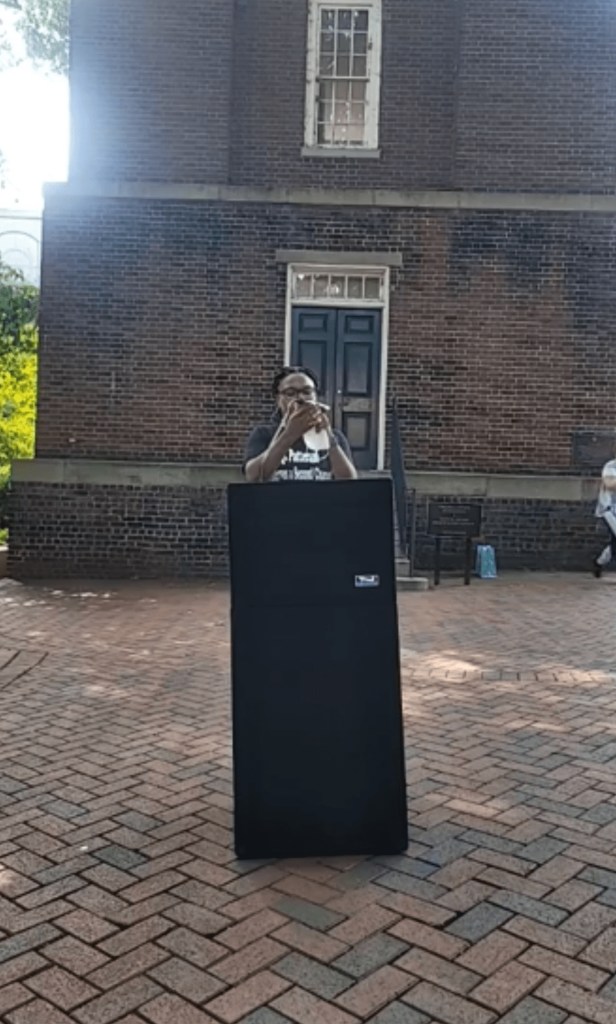
Speech by Q at the Rally Against Earned Sentence Credit Revocation

Listen as Q speaks at the rally about what it’s like to be incarcerated right now, and what it’s like to do too much time. He also addresses all of us out here and reminds us how much WE can take action and show up as families of the incarcerated. Thank you to Voice for the Voiceless, Humanization Project, Delegate Don Scott and others who were able to show support today. The work isn’t done!

Our editor, Santia, holds an iPhone to the microphone for the public to hear.

Too Much Time: July Prompt

It’s been about a month since Governor Youngkin dastardly used his power to amend the state’s budget and deny thousands of deserved inmates a chance at an earlier start on a new life in the free world…

Advocates have rallied in the name of those incarcerated. Media outlets have been taking notice. The time has come for us who are imprisoned to speak for ourselves… WE have a voice, and we have a platform. Brilliance Behind Bars belongs to us all. Let’s let the world know what goes on behind the walls – the things apathetic politicians deliberately hide from the public eye…

Write an essay, compose a poem, or just drop some quotes describing your personal struggles in the penitentiary for your own rehabilitation, and explain how the denial of justice has affected you and your family. Explain to the public, legislators, advocates, etc. why you deserve a shot at an earlier release date. Remember: the world is really taking notice now. Let your voices be heard!

Do not forget to include your name and any contact information for any readers who may be able to offer you some assistance.

I have more love than you can imagine for each and every one of my brothers and sisters on this side of the struggle. I pray we find the light in these dark times.

Sending love, blessing, strength, and hope,
-Q

On Second Look: Incarceration is just another word for nothing left to lose.

There is a song by Janis Joplin where she says “FREEDOM is just another word for nothing left to lose.” I thought about those lyrics and what they mean, then I changed the word FREEDOM to INCARCERATION and it speaks to me in an entirely different way. Context is everything … looking at someone or something today with the eyes of yesterday is the best way to stagnate, ignore and even deny progress.

In life, we have the opportunity to Forgive and Learn. Forgiveness comes from the heart of those offended as a part of their healing process and the lesson is learned by the offender thru the penalty received. In terms of incarceration, its not the amount of time imposed but what you do with that time to atone… and once that lesson is learned, the cycle is complete.

“Second Look” in lieu of parole or more sensible good time laws for exorbitant sentences allows for a fresh set of eyes to review and determine if the aforementioned cycle is complete. Most of those in opposition to any significant prison reforms are denying not only those incarcerated, but themselves of the invaluable gift of growth, as well as the ability to learn and forgive. Unfortunately, personal agendas and biases (both implicit and explicit) continue to block the path to real justice in Virginia, so this has to be addressed if one is to reasonably expect anything different.

Telling people that they are irredeemable by using this strictly punitive and archaic sentencing structure (85%, no parole), then releasing them into society anyway after 30, 40 or 50 years of incarceration does society no good… Has it stopped crime? NO! Has it been a deterrent of any kind? NO! It has no benefit other than retribution.

Wasting a human resource out of spite should actually be a crime itself. 26 years of this system and what you have are packed, understaffed prisons – and some of which need drastic renovations or need to be closed down altogether and a state budget nightmare for years to come.

The punishment of incarcerating someone now isn’t just about doing the time imposed on you when you’re sentenced…. its doing so much of it that when you’re released to the world, you have no real time left.

Depending on how this Second Look legislation is structured and implemented, that will determine its success and benefit… whether or not it means that every year after a certain point in a persons sentence they will be evaluated (by unbiased and subjective people, not a computer algorithm) on a scale that is evidence based, or if its only for those like myself incarcerated at 18 years old, now 41, and about to embark on my 24th year of a 45-year sentence – still having another 18 years before my mandatory release date?

This legislation also has to be retroactive and all inclusive (for violent and non-violent) in order to be fair and combat some of the damage done by the 85%, no parole laws. Either way, there is no downside to review someone after a certain point in their incarceration, that’s the humane thing to do… its why parole and good time credits exist (not in Virginia).

However, what I don’t want to see is another mechanism in place that feels its sole function is to just keep people in prison regardless of any proven change in mindset and behavior. That seems to be what the republicans believe the parole board is supposed to do… just rubber stamp NO or DENIED on every review. There is a point that you reach while incarcerated when there is nothing left to do but sit idle while life passes you by… you have completed everything available to you and mandated to you by the state, and then reached beyond that on your own to do more for yourself and your family, but then you sit and lose it all because you still have another 20 or 30 years before your release date. Second look legislation can fix that issue and much more.

Let’s be honest for a minute though: if 60% of Virginia’s prison population were white, WE WOULDN’T BE HAVING THIS CONVERSATION, nor would we still begging to fix what any person with a conscious has agreed are bad laws.

Lastly, I keep hearing people falsely claim that change is a process and then use that as an excuse not to do anything to help the so called “process” … Change is NOT a process, its a RESULT! With regards to people… CHANGE is what happens when an individual or a group of individuals are 100% dissatisfied with their current circumstances or conditions.

I could go through and give historical precedence b.u.t. I don’t see the need because if you’re still reading this, you already know I’m right.

Peace!

– Sincere Born Allah, #1131459, Nottoway Correctional Center

A Thin Line Between a Hero and a Criminal, Q’s Origin Story

I’m not sure how many people understand how thin of a line there is between the path of being a criminal, and the path of being a hero — other than the people who have walked it. More so, the people who have unfortunately stumbled upon the darker side.

I have been incarcerated going fourteen years now. Over this time, I’ve lost my grandmother, chose to pick up the practice of prayer and meditation, and through the help of a loved one, been able to embrace my great desire for higher education. Reflecting on my life, I’ve been able to ascertain the point where it all changed for me — a childhood experience where I trickled over the line where hero meets villain.

I’ve always considered myself a good kid. After several different location changes in my childhood, concepts like school and friends did not have the time to take an impacting hold on my life. However, I’ve always honored my parents, respected my elders, and was always ready to help anyone I could, when I could. My mother struggled with jobs and relationships as she tried to raise my siblings and I. She didn’t have enough energy to work long hours, endured massive migraines, chased behind three pre-teenaged boys (and a baby girl), on top of being very poor. An over-premissive parenting style seemed the viable option for her, so my brothers and I were free to roam and interpret the world on our own. Innocent enough, all of these factors set the ground for the childhood experience that changed my life.

I was ten years old when my family moved to a housing project in Durham, NC. Then, the Pokémon craze had set in heavy. Everyone had their gameboys, the videogames, and the trading cards. This craze didn’t fail to reach me either. I was totally in love with all things Pokémon.

I was at a cousin’s house, walking around their neighborhood. I was showing my cousins my rare holographic Pokémon cards, when a group of three older, unfamiliar kids walked up. I remember them clearly. One was a light-skinned boy, his hair was unkept and his clothes were a bit ragged and dirty. There was a kid who was big and round, he wore an old dress shirt that was too small for him, some old khaki pants and had a chipped tooth. The third was a very small boy who looked way younger than us. He had a bandana wrapped around his head with the knot tied to the front. “Hey, let me see those,” the light-skinned boy said. I looked at him with a smile on my face, and without hesitation gave him the cards in my hand. Excitedly, I began to explain the different cards and my love of Pokémon. Suddenly, he punched me in the shoulder and said, “These are mine now,” he then jumped back and threw up his fists in a fighter’s stance. I looked at him in amazement for a second before I understood what was going on. Outside of play – wrestling around with my brothers on the living room floor, I never had been in a fight before. Recognizing what was happening, I took a stance in defense of myself and my property. We danced in a circle, and before any strike was thrown, I saw a shiny piece of chrome glimmer in the corner of my eye, and then was frozen in astonishment. “What you gonna do now!?” is what the tiny bandana-ed boy said as he pointed a small handgun at my face. My mind and body were locked in place. Of course, I had never since an actual gun before, but being predisposed to cartoons, movies, and video games, I knew just how deadly a gun could be. Noticing how petrified I was, the boys turned away and fled with laughter and my trading cards in tow.

Seeing them disappear behind the houses of the neighborhood, anger and sadness boiled up inside of me. A raging ball of newly recognized emotions exploded, and I just erupted into tears. I sat on the porch of my cousin’s friend’s house shaking uncontrollably and bawling with my head in my lap. My younger brother sat beside me, his hand was rubbing me on my back in an attempt to comfort me. Strangely, I felt shame, cowardice, and disgust with myself. “Why didn’t I do something!? Why was I so afraid?” I cried inside and began I blame myself for being too kind, for giving the boy my cards. I looked at my little brother… I wanted to be strong for him, be his hero, and I felt like I had let him down. Through tear-filled eyes, I looked him in the face and cried out a promise, “I will never let anyone take anything away from me again!” Little did I know, that day and that promise would change my life forever.

Not too long after that encounter, I found it harder to walk away from confrontation or any type of situation that I could prove how brave I was. I found it harder to walk away from fights with the other kids, to walk away from challenges of thievery and delinquency. My behavior lead me to a childhood of truancy, underaged drinking, doing drugs and even joining a gang at the age of eleven. I no longer felt like a coward or a victim, but I didn’t realize at that age, that I was victimizing my mother and eventually myself with my erroneous quest for bravery. As a child, its hard to determine the line between being a hero and a villain. Even as adults, we look at most criminals as fearless or unhinged. These assumptions are not entirely true. Most of us here in prison were fatherless, scared children who managed our fear in distressing environments by imitating what we thought was brave.

Through meditation, prayer, and education, I’ve now come to realize what bravery truly is. I earned my GED within my first years of incarceration. I have been mentoring young men for over 10 years, helping them find their own spiritual journeys, tutoring various subjects, and motivating them to seek higher education. I currently take print-based college courses at Ohio University, studying to receive a degree in social sciences. I plan to use my education, reinforced by my experience to help deter youths who have fallen on the wrong side of that thin line. I also want to work with local legislators to create policies that support them.

While I’ve been able to achieve this level of growth during my incarceration, my story did not have to have this chapter of imprisonment. That leaves me with the questions: How can we save those noble little boys out there who are only seeking to be heroes? How do we teach them not only courage, but righteousness and strength, without ever having them see a jail cell? Through my story, I hope to increase the awareness that the world is full of these misguided good kids, who didn’t have a proper chance to find the heroes they truly were, before it was too late. If we can do a better job of identifying these special children, we can help them be more than just villains society believes deserve nothing more than a life of incarceration. We can create more heroes…

Our mission focuses on remembering the brilliance behind bars, giving incarcerated people who want to be heroes a chance to show the world that they CAN be.

– Q. Patterson, Creator and Organizer of BrillinaceBehindBars.com

The Greatest Joy

My name is Shaveek Pittman and I am currently in Lawrenceville Correctional Center. I lived in Fredericksburg, Virginia for about 5 or 6 years. I have had quite a few different experiences since moving to VA from New Jersey, and this is why I can relate so well to this quote from Malcolm X that I chose for this assignment.

This quote from Malcolm X that I chose says: “It is only after the deepest darkness, that the greatest joy can come; it is only after slavery and prison, that the sweetest appreciation can come.”

It is self explanatory what is being said here, but still so many people feel as though they can understand what prisoners, minorities and everyone else suffering from some form of poverty are going through – simply because they read a book or heard about it from another source. The truth is: unless you have fallen under this category yourself, it is highly unlikely that you will ever truly understand the struggle that those who are at the bottom of society must endure.

For all of those people who can relate to these difficult circumstances, the meaning of this quote brings us hope to keep pushing forward, because your time of success and liberation are inevitable. It may be difficult to see this through the thick darkness that permeates the world we live in, but all it takes is just a little patience, a little perseverance and every step of the way becomes much clearer.

This invisible line we have drawn between the upper class and the lower classes is totally dependent on the lower class’ willingness to subject ourselves to the ways of the world. For example, there are many blacks who would agree that in terms of jobs and careers, we will always get “the short end of the stick,” unless we are privileged enough to be given an opportunity to establish ourselves in this corporate America.

The problem with this outlook will always be that – until we understand that this country was built on freedom, justice and equality, there will continue to be roadblocks everywhere we go. These roadblocks may have been set up in the interests of those who seek to control the masses, but it’s actually an indicator that we all do not have to walk the same paths in order to be prosperous and to free ourselves from whatever obstacles stand in our way.

– Shaveek Pittman Contributing Writer | Fredericksburg, Virginia #1870834