Taxation Without Representation

Formerly Incarcerated Citizens and Civil / Political Disability

By Danny Ray Thomas

When returning citizens reenter society, probation and parole expects us to immediately find employment and begin the process of developing as productive citizens. Our paychecks have the same withholdings just as anyone else in the workforce. By April 15th of every year, we’re required to have our taxes filed, and if we’re lucky we’ll get a refund. In other instances, we’re told we owe money or funds are withheld for child support or other debts the state or federal government have made claims to.

What has always concerned me is the fact that we can be taxed as anyone else without restoration, yet we cannot vote without permission. Our tax dollars will assist in funding schools and first responders, ironically our tax dollars also pay the probation officer who’ll violate us and send us back to prison where our taxes will also pay the corrections officers and prison officials who’ll stand watch over us.

Well after incarcerated citizens complete their sentence, we remain “civilly disabled.” Why is it that we lose the right to determine which legislators and other politicians determine what’s best for the communities we live in? This is clearly “retribution,” which is considered one of the (4) four goals of incarceration, the other three being, societal protection, deterrence, and punishment. In some instances, the Courts have referenced “rehabilitation” as a fifth, but refuting that fallacy would be encyclopedic in length.

In any event, we remain “civiliter mortuus” (civilly dead) to the state which not only impacts our right to vote on the local level. Clearly this makes no sense. Again, we don’t have to prove ourselves to pay taxes yet we must do so to vote. I’d love to hear Governor Youngkin’s answer to this question; better yet, I’d like to be a fly on the wall when he’s discussing this issue behind closed doors!

Governor Youngkin is empowered to remove what the Courts refer to as “political disabilities,” but not all rights lost as a result of a felony conviction, for instance, the jurisdiction to restore firearm rights lost in those circumstances is vested in the circuit court. The Virginia Constitution allows the Governor of Virginia to individually restore political rights of convicted felons without judicial review, see the
Va. Constitution article V, section 12.

Restoration of the right to vote, hold public office, to serve on a jury, or be notary public does not constitute an inherent danger to public safety or does it? Maybe this is true for those in power that realize the power of the formerly incarcerated citizen.We all know that old addage “givem an inch they’ll take a mile!

Today we’ll vote, tomorrow we’ll serve on a jury, the day after we’ll hold public office. Neither aspiration of serving on a jury or holding public office can occur without the initial ability to vote. If they nullify our ability to vote, they also nullify our ability to have a direct impact on the system. It’s obvious which side of the aisle the ‘formerly incarcerated citizen’ stands on, can someone say “Progressive!”

In 2016, Governor Terry McAullife used his executive power to restore voting rights to more than 200,000 former prisoners in response to campaigns to end felony disenfranchisement. “I remain committed to moving past our Commonwealth’s history of injustice to embrace an honest process for restoring the rights of our citizens,” the governor said.”The struggle for civil rights has always been a long and difficult journey but the fight goes on.Unfortunately, republicans challenged the Governor’s executive order to The Virginia Supreme Court and the court determined that Governor McAuliffe did not have the authority to restore these rights without an individual application by each petitioner. Howell v. McAullife , 292 Va. 320.

The opposition to the restoration of voting rights to the formerly incarcerated has created an attitude of pessimism and defeat in many. My message to them is simple, “If voting doesn’t matter, why do they fight so hard to keep you from participating in the process?”

In Struggle,
D Ray Thomas, Green Rock Correctional, #1054249

My name is Danny Ray Thomas and I’ve been incarcerated for 21 years. I am from Pittsylvania county just outside of Danville, Va. I currently reside at Green Rock Correctional and I work as the Treatment aide. I work with counselors teaching anger management, thinking for a change, victim impact and ready to work.I am an activist and mentor in this community of men. I’m not one who’d shy away from the struggle we face, instead I embrace it. I’ve written for the “unlocked project,” a collaboration between the Coalition for Justice and Virginia Tech. I’ve also written for NYU ‘s review of law and social change publication called “The Harbinger,” my piece with them is called “The Calamity of Sentencing in Virginia” which can be found at http://www.socialchangenyu.com.I am also a part of NYU’s “Jailhouse Lawyer’s Initiative. Needless to say I am a student of this movement against mass incarceration and I look forwarded to collaborating with anyone who feels the same as I do.

My American Citizenship

I want to touch on voting and on enhanced earned sentence reductions. The right to vote is fundamental to any civilized nation. As is the right to liberty, justice, and the pursuit of happiness. Should I, as an inmate and convicted felon, lose these things? No. It is true that I have lost a portion of my freedom, but only a portion. I am still covered by the Bill of Rights and the Constitutions of the United States of America and the Commonwealth of Virginia. I did not lose my American citizenship when I was convicted of my crime. I did not cease to be a resident in the Commonwealth of Virginia. So why should I, as an American citizen and a resident of the Commonwealth of Virginia, lose my right to vote just because I was convicted of a felony? The answer is simple, because it is a way to further punish me and because most Republicans believe allowing me to vote will cost them elections. Now that’s not how Conservatives will frame their argument against my right to vote of course. They will claim, with a very staunch look, that removing a convicted felon’s right to vote is a deterrent to crime. Honestly, though, have you ever heard anyone say they aren’t going to commit a felony because they will lose their right to vote? Nobody has. So here is the crux of my position on convicted felons, incarcerated or not, voting. If it is constitutional to take away the right to vote from an American citizen and a resident of the Commonwealth of Virginia because he or she committed a felony, then who is next? What’s to stop the government from taking away the right to vote from people who are pro choice? What’s to stop the government from taking away the right to vote from people who are Muslim? Now you are probably saying the Constitution stops them. Well, it didn’t stop them from taking away the right to vote from felons who are covered by the same Constitution of which you are speaking. Let me be fair though. I have been on both sides of the criminal justice system. I do fully understand stripping some rights away from convicted felons. I understand stripping a convicted felon of his or her right to bear arms. I understand stripping a convicted felon of some of his or her protections against searches and seizures. These things are done for the protection of society at large. But how is anyone protected by denying convicted felons the right to vote? They aren’t. That takes us back to my earlier point, denying convicted felons the right to vote is nothing more than further punishment. It is a Conservative stance to show that they are tough on crime and a product of their fear that allowing convicted felons to vote will cost them elections. However, I don’t think anyone believes it is constitutional to deny someone the right to vote just because they won’t vote the way you want them to. Yet that is what is happening to convicted felons each time we have an election.

Now to my second point, enhanced earned sentence reductions. These reductions make good sense on a number of levels. First, they make prisons safer for inmates, officers, and staff. The more an inmate has to lose, the more that inmate will think before doing something wrong. The less an inmate has to lose, the less that inmate will care about doing wrong. Second, giving an inmate the chance to earn credits toward a sentence reduction gives an inmate hope and something to work for. Hope and purpose are essential to anyone’s mental and physical wellbeing, especially an inmate’s. Now I realize that Departments of Correction do a great job of talking about rehabilitation, but that is basically all smoke and mirrors. The reality is that they do the absolute bare minimum to even try and rehabilitate anyone. That leaves rehabilitation in the hands of the inmate. He or she must take the initiative to better themselves. However, for most inmates that seems pointless. What is the point in trying to better yourself when you are not rewarded for it? Therefore, I have an idea I would like to see implemented in Virginia and other states as well. As the federal government makes pell grants more available, I believe this idea will become more and more implementable. Many inmates leaving prison are behind the eight ball educationally when they seek employment. I propose that states enact legislation that allows an inmate to earn enhanced sentence reductions for every degree the inmate receives while incarcerated. States could provide an inmate with a five percent reduction in their sentence for each degree they earn, on top of their good behavior reduction. This would make for smarter and more knowledgeable inmates. It would make for more qualified and employable men and women looking to join the workplace following prison. It would improve the mental and physical wellbeing of inmates. It would allow inmates a quicker transition back into society. It would allow inmates the opportunity to do something that would bring themselves, their families, and their loved ones a sense of pride and accomplishment. And it would keep inmates busy, leaving them less time to get into trouble. I firmly believe this program would benefit the States, the inmates, inmates’ families, employers, society, and our nation as a whole.

Travis Sorrells, Haynesville Correctional Center

BIO: Currently, I am about nine years into a fifteen year sentence. I am also seeking a Theological Degree through International Christian College and Seminary. My goal during this time is to make myself as ready as possible to reenter society in a way that allows me to be both productive and contributive.

“Make Them An Offer They Can’t Refuse.”

On the topic of freedom that comes with the right to vote, is something that is very important also productive, because the person that votes can put the right people in office to change the world. But, only if you know who you’re voting for and why.

A lot of people get caught up by politician’s telling you a lie. They sell you a dream to get your vote, but the whole time they have another agenda they’ve kept from you. They’ve pulled the wool over your eyes and then once they get in office, you never receive your promise that you thought was going to happen. There’s power in the freedom to vote. Governor Glenn Youngkin knows that, which is why he went under the table and recently overturned felon’s right to vote. He made it harder to get our voting rights because he knows him and others can’t continue to win elections if too many of us have a chance to vote. Virginia doesn’t want us to have freedom to vote because it’s power – too much power in their eyes – and they know they will lose.

I often talk to people and everybody says they want change, but at the same time, they don’t want to put the work in and vote or help some other way to make a difference. All they want is a hand out, and that’ll never happen. I like to use a quote from the (God Father movie): “Make them an offer they can’t refuse,” and you do that by voting the right candidate into office and change will come for prison reform as well as state laws.

My wife and I are involved in getting people to vote by trying to convince them, even when they are skeptical. She works for an organization and she often talks to future delegates and senators to vet them out to see if they are the right person to get in office.

If every American could vote, the laws would be so different in this country. I would say it would be more better than worst a lot would be different maybe the right people would be in congress and we could get Black Americans in the constitution, instead of just having privileges. To all my people: know that you can make a change in the world by voting or doing what you can. It’s a process that’s been going on for over a hundred years. So please make Virginia a better state and go out and vote.

Peace and Blessings,
Allen Jackson

My name is Allen Jackson and I was born in Charlottesville, Va and was raised in Charlottesville, Louisa, and Richmond.

What’s Free 2023!? – Voting.

Editor’s Note: What’s Free is a column that began in 2020, that asks the incarcerated community what freedom means to them. Inspired by the movement of enhanced earned sentence credits, we have raised the topic every year to keep the momentum alive as more brothers and sisters remain behind bars in the Virginia prison system. This year, Q has decided to talk about the freedom that comes with participating in our political system.

Virginia criminal justice reform has been shifting back in forth between a full, most needed overhaul and virtual crumbs to keep the majority of our loved ones seeking more from our state leaders. This year though, one hundred seats in the Virginia House of Representatives are up for reelection. This is where the power of the vote will have its greatest chance to reflect the voices of the incarcerated in the form of our loved ones active participation in the voting process.

When it comes to voting and change as a whole, all of us who have been dejected by the losses we’ve taken must be wary of a most destructive attitude – political skepticism – which only serves to keep the chains on the mind, soul, and in our case, the body.

It’s no secret: every stride gained in regards to who gets to vote in America, has come by way of combat. Normally, this form of combat has placed minorities in position of a proverbial David versus the very real Goliath of bigotry and racism. Continuous combat of this nature will leave a sense of dread and despair no matter how many times we have overcome…

For example, for the last 10 years, Virginia governors fought to ease the path to Restoration of ex-felons rights. In a single term, Glenn Youngkin secretly rolled back automatic expungement without ever addressing the public about the change. But why? What does Glenn Youngkin have to fear from a fuller version of the right to vote? He has to fear YOU!

Political skepticism is the biggest threat to change. Feeling like your vote doesn’t matter, your voice won’t change anything, that the vote is ‘rigged,’ are all thoughts that trap you in a form of political slavery where you willingly give up your fate to the hands of those who’ve already condemned you.

We’ve already heard the stories about how vicious southerners became when former slaves were granted the right to vote. Through those acts of brutality and intimidation, we can surmise how important and powerful the vote is in this country. Even in modern day – look at how Donald Trump played with the idea of the vote being rigged to charge up his base and turned them on the capitol.

Minorities often complain about how politicians are constantly pandering them – encouraging them to get out and vote for them – yet minorities are still skeptical about whether their vote even matters. The fact is that Democrats need a large portion of the minority vote to win the presidential office in any given year.

Let’s look at it this way: if the vote is real (which I most certainly believe it is), then not going out to vote has very real life-costing consequences. The greatest threat that must be overcome is the captive thinking of political skepticism.

What’s Free!? Freedom in this country looks like every single American voting in EVERY election – whether they’re an ex-felon, incarcerated, or free.

-Q

Prompt Questions (Thought Starters for the Incarcerated Population):

  • Can you identify examples of political skepticism in your every day life? Does it affect you? Why or why not?
  • How do you feel about the recent changes Govorner Youngkin made to the restoration of rights?
  • Being ineligible to vote yourself, how do you plan to be involved in the upcoming state elections for the Virginia General Assembly members?
  • How do you think that society can benefit from every American being able to vote?

The Loudest Voice is Our Vote

While sitting in the Birmingham jail, Dr. Martin Luther King Jr. wrote in longhand his famous “Letter from Birmingham Jail.” Within this letter, he stated how he couldn’t sit idly by in Atlanta, his home state, and not be concerned about what was happening in Birmingham. Whatever affects one directly, affects all indirectly.

In my 23 years of incarceration, I live with the direct result of an injustices I created. This injustice is now effecting me and many others and that injustice is: “NOT VOTING.”

In November of 1994, my late father-in-law warned me of not voting. It was during this time that Mr. George Allen was campaigning for governor. His campaign was fueled by the ‘tough on crime’ mantra, with the abolishing of parole as the prize for electing him as governor. I never paid much attention. And to be honest I really didn’t care. Never in a million years did I think that abolishing parole would become like a modern day genocide.

I know that crime must be dealt with, and we all want a safe society. However, many make mistakes, are remorseful and seek rehabilitation to become a better person.

Now in 2023, I find myself facing a very lengthy prison sentence, without the possibility of parole. During these past 20 years, I have met many individuals, some guilty, and a few not guilty. I’ve also met many who, through the rehabilitative process are better and different people today. But the majority of us continue to find ourselves at the mercy of the governor to one day enjoy the freedom that we took for granted and forfeited.

I didn’t vote in 1994, the following year (1995), he fulfilled his promise and abolished parole in Virginia. I’m living in the results of not voting. Many think that my one vote doesn’t matter, just think in a small town, someone won a school board seat winning 3 to 2. Voting matters from our local elections to the highest elections. Voting is actually your voice!!

I lost my right to vote; now, I try to inspire others to vote. I speak to inmates often telling them to encourage their family to vote. Yes, we’ve lost our rights to vote. But think if each of the 37,000 plus inmates in Virginia would inspire 10 people to vote, that would be would be 370,000 votes cast. Yes, it would be in different districts, but I promise you this would make a difference.

So inspire your family and friends to vote. When they ask if they can help, say yes, Vote!! Also tell them to get in touch with their elected officials, from their local representative (senate and delegate) to your national (senate and delegate) prior to elections. If these elected officials will not return your email, letter, or call, then thats a blatant example of them not EARNING your vote.

It’s time that they realize that our votes must not be taken for granted but must be earned.
Let them know what issues effect you and your community. These elected officials are there because of you and for you.

It’s time that we stop being “Democrats, Independent or Republican.” We are humans with a voice, and the loudest voice is our VOTE. It’s time that they stop taking us for granted. Many have gone before us before us, oftentimes being jailed and treated harshly for wanting to vote. We no longer have to count the “jelly beans” in jar. We just have to register. Pass on the importance of voting on to your kids.

To my fellow ex offenders, vote for us! Make getting your rights restored a priority. Speak out for change.
Its time that we stop giving away what many others earned through their blood, sweat, tears and some death.

Many died for us to have the right to vote, don’t give it away, because this injustice is a threat to justice everywhere.

Samuel E Harris #1026738
Lawrenceville Correctional Center

Suffolk, Virginia

(Sam) a successful car salesman in the Tidewater Area who suffered an accident while in service to his country and later diagnosed with PTSD by the Department of Veterans Affairs, but later denied treatment due to bureaucratic red-tape, caused him to self-medicate and lead to his incarceration for robbery with a 220 year sentence, with 60 to serve. In spite of his situation of incarceration, he has used the last 23 years to rehabilitate and become the devout man of God he is, that has served others through the positions and platforms he’s held within prison. He’s also co-authored several books :”Beyond The Shackles” and ” Speaking Out for Change” as well as authoring his own book ” A Double Minded Man” soon to be released. He can be contacted via US mail or email @ JPay.com Samuel E Harris #1026738

PROTECT THE BLACK VOTE

by Lord Serious

The Black vote in America is constantly under attack. For this country to proclaim itself as the greatest democracy in the world – while at the same time it systematically devises new schemes and policies to dilute and undermine the Black vote – is not only hypocritical, it is also criminal. Since being kidnapped and brought to these shores, our people have had our Black skin criminalized and have been forced to live in chains and shackles by our White enslavers. These White overseers have consistently used the institution of slavery to dehumanize us and to justify their undemocratic suppression of the Black vote!

I remember the first time I registered to vote. It was in the summer time and I had just stopped at the neighborhood community center when I was approached by someone who asked me if I was registered to vote. I was not registered and I really hadn’t given much thought to it until that moment. I was 18 and I would be turning 19 after the upcoming November election. So as I filled out the form, I grew excited about having the opportunity to vote. I didn’t know anything about the candidates or their policies and truthfully, I didn’t care. My mother had told me we were democrats and so I was planning to vote for every democrat who name appeared on the ballot. This was in the year 2005.

As time passed, the election had totally slipped my mind. So when the first Tuesday of November arrived and I seen the line of people waiting to cast their ballots outside of the community center, I suddenly remembered that this was my chance to vote. So I parked my car and I got in line. The experience was new and exciting. There were people electioneering telling us which candidate we should vote for and why their policies would benefit us more than what their competitor had to offer. But they were only allowed to go a certain distance with us before we left them behind as the line progressed closer to the entrance. This wasn’t a presidential election so I didn’t have to wait for hours, I made it inside within maybe 30 minutes. And then, I finally reached the person who looks like they’re the gatekeeper. This person was sitting at a table right in front of the doors that led to the gym area where the voting machines where stationed and they had a list of names. When they asked for my name I proudly told them, “James Rickey Boughton, Jr.” and I gave them my address. But when they asked for my ID I stuck my hands in my pants pockets and I could not locate my ID anywhere! The gatekeeper then asked if I had my social security card with me? But I did not and when I could not produce any form of identification, I was turned away.

I was disappointed and frustrated by the whole ordeal. I had totally forgotten all about the election and the only reason I did stop was because I saw the people standing in line and the signs in front of the community center. But, had I left home with the intentions of going to vote I would have taken the proper identification with me. But I had other business to attend to, so I didn’t have time to go back home to retrieve my ID and then spend another 30 minutes waiting in that long line.

My next experience with voting was just as disappointing as the first. This time, I was detained in the city jail awaiting trial for the charges that eventually sent me to prison for the sentence I’m currently serving today. The 2008 Presidential election was projected to be the most historic election in modern history, and inmates in the jail who had never been convicted of a felony, technically still retained their right to vote. So we were informed by employees of the Sheriff’s department that we could vote in the upcoming election. This was exciting news and I couldn’t wait to vote for Obama and help elect a Black man to the highest seat in office. I asked Captains, Lieutenants and Sergeants about when I could I register and I was eventually provided some documents to sign. But no one ever provided me with an absentee ballot or a mail in ballot. And on the day of the election, I asked members of the Sheriff’s department when would I be able to vote and they claimed that the organization who was responsible for organizing the entire thing never provided the jail with the ballots for its inmates. So once again, I found my efforts to exercise my right to vote thwarted by red tape.

Today, we see states like Georgia passing new laws to target and discourage Black’s from participating in the voting process. And I can speak from experience that restrictive ID laws do discourage people and interfere with their right to cast their ballot. Furthermore, mass incarceration (our generation’s version of modern day slavery) has been used to deny many Blacks access to the ballot box. As I’ve shown you from my own personal experience, I had been denied bond, therefore, I was being detained in the city jail before I had even been to trial. I had never been convicted of any felony prior to the 2008 election, and I had every right to exercise my right vote. But due to what I believe was voter suppression being committed by the Sheriff’s department, I was denied access to the ballot. So if laws are being passed that will make these kinds of undemocratic practices illegal, then I think they are very necessary to protect the Black vote.

Lord Serious is an author, a blogger, and a podcaster. You can follow him on Instagram and Facebook at Lord Serious Speaks and you can learn more about him by visiting his website www.LordSeriousSpeaks.com.

Just Maybe

Just maybe,
if I wasn’t considered 3/5ths of a hue-man being
and stripped of my nationality and creed by Europeans,
my right to vote would not denied or abridged,
my citizenship would not be secondary to his.
I would not be treated apparently with racial disparity,
my vote is my voice, my moment of clarity.

Just maybe,
if I knew the power of the vote before imprisonment
and realized the inability to vote was a hindrance
I would not be looked at as insignificant.
Just maybe, I would be treated with equality,
and not defeated by poverty.
just maybe,
they would understand my people’s psychology.

Just maybe,
if my political views weren’t misconstrued as being racist, or me being bias.
Just maybe, my views come from me being tired,
and me being bullied by Goliath.
What is power, but an illusion driven by force?
What better way to gain control than imprison the source?

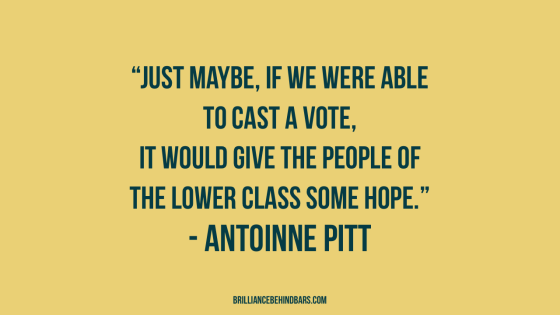
Just maybe, if we were able to cast a vote,
It would give the people of the lower class some hope.
Just maybe…

My name is Antoinne Pitt, I am from Portsmouth, Virginia, currently incarcerated at Lawrenceville Correctional Center. I am the author of Thinking With A Purpose, which is a curriculum created to reduce the rate of recidivism and prevent criminal thinking and influences and the author of C.O.A.T (Countering Overdoses and Addiction Treatment) a curriculum created to combat the opioid epidemic that has plagued our nation. You can contact my publisher, Winter Giovanni, for additional information or go to www.infinitypublicationsllc.net to see my bio. You can also support my fight for freedom by signing my change.org petition, or writing a support letter to: the Secretary Of Commonwealth, P.O. Box 2454 Richmond, VA 23218- 2454.

Peace and Blessings.

Prompt: The Incarcerated Vote

HR 1 is a voting rights bill that if it was passed in its original form, would have restored the rights of incarcerated people and ex-felons to vote in federal elections. The bill has long been amended solely to restoring the voting rights of ex-felons, but it also brought attention to another intriguing aspect I’m sure most people probably don’t know.

For centuries at the behest of the white establishment, minorities have been disproportionately policed, jailed, and imprisoned. Beyond stripping the lives away from young black and brown men in this country, states have found ways to actually profit from putting minorities in prison economically evidently, but more interesting, politically.

HR 1 identifies a law that allows counties with prisons to have people they house counted toward that county’s population on the U.S. census. Thereby pilfering the population of multicultural, urban (largely Democratic) areas and adding them to rural, largely white (largely Republican) areas. All the while, eviscerating the incarcerated person’s right to vote. This dynamic is the core of what can be considered as politically-motivated slavery.

With the reallocation of the urban populace to these rural areas, the voice of the people is stricken from a more accurate representation of the people, and is instead granted to a more diluted form of constituents who would be more likely in favor of continuing the trend of mass incarceration, post-millennium slavery, and the further exploition of black and brown people for personal and monetary gain.

HR 1 intends to correct that law and return the population of those incarcerated back to their hometowns… There has been much work in recent legislation concerning criminal justice reform to correct the racist systemic devices that have been used to disenfranchise droves of minorities in America for a majority of its history, however the threat of the old establishment looms over us all, impeding our progression to a more perfect union. Awareness is the first step, activism is the following one.

Know that the bile of racism runs deep, and its effects are subtle. The old guard feared that we, as a people, would become aware, so they withheld education and knowledge from us for centuries. But what they fear most is that, armed with such education and knowledge of self, we would actually do something about it, so they try to break and discourage us, and even pit us against one another. We must understand that we are solely responsible for making sure that their every effort from here on out is made in vain. Times ARE changing. We, at this moment, may not be able to enjoy a world truly free of systemic racism before our time is up, but be sure, our efforts now will be the catalyst for the world our future generations will experience…

I extend my love to each and everyone seeking freedom, not only for themselves, but the world now and the world to come…

Love, peace, and action…
-Q.

Prompt For Incarcerated People: Compose an essay, poem, art, or any other form of creative expression you may have. Think about your experience participating and learning about the political process. Below is a list of questions meant to serve as inspiration for your piece.

  • What is your experience with voting and the political system before and after incarceration?
  • What are your thoughts on voting while incarcerated?
  • How can we change the point of view on letting incarcerated people vote?
  • How has participating in the political system impacted your life?
  • Are you more educated about the system now than you were back then?
  • How would being able to vote change your life?

Make sure to let the people know who you are, where you’re from, and any project(s) you may have or have been involved with so we can promote it. Thank you for your contribution. We are working together to bring awareness to the brilliance they have locked away behind bars.

Thank you to the readers of BrillianceBehindBars.com. Answers to this prompt will be coming in through April of 2021 from those incarcerated across Virginia.