Your Vote Matters

By: Joshua Hairston

Amendment XV (15)

Passed by Congress February 26, 1869. Ratified February 3, 1870.

Section 1.
The right of citizens of the United States to vote shall not be denied or abridged by the United States or by any State on account of race, color, or previous condition of servitude…

Recently, after conversing with the eldest of my brothers, I found myself disheartened; his lack of appreciation for his civil rights, the inexorable firmness he exhibited in being indifferent toward the summons of those in position to represent his interests, my own disconcerting effort to inspire in him a deeper sense of attachment to these privileges, all worked to frustrate me beyond the etiquette of tolerance that accompanies my belief in self-determination.

For several years now, I have pitched to him, using differing approaches, recognizing the vicissitude of the African American experience, the importance of him, a young inner-city black, casting his ballot.

“The historian Edmund S. Morgan argues…that well-off white Virginians…could champion a form of republican representative government defined by the absence of a formal ruling class or monarchy without threatening their own status as elites for one simple reason: They knew that the system of slavery meant that most of the poor in Virginia were enslaved, SO THEY HAD NO LEGAL RIGHTS AND COULD NEVER PARTICIPATE IN POLITICS.” – The 1619 Project

“1857 Dred Scott…Supreme Court decided Mar. 6…BLACKS WERE NOT AND COULD NOT BE CITIZENS.” (The Court also ruled that slaves were not citizens of any state nor of the U.S.) – The World Almanac And Book Of Facts

Foolheartedly, I support his choice to articulate and actualize perspectives and values that contextualize his experience. Vindicating himself pursuing that which concerns him most. Expressing, openly, his ideas of freedom.

However, I fear that to offer approval, even if only for the inalienable right of choice, to anyone who proclaims such as their stance dismisses the sacrifices made in advancing the African American, in a manner so transgressive, it warrants severe objection.

“Congress then passed the Thirteenth, Fourteenth, and Fifteenth Amendments abolishing slavery, making blacks citizens, and giving them the right to vote.”

The progress encompassed in these Amendments, a consequence of suffering generations of subjugation, oppression, and deprivation – an infinitesimal return on the spilled blood and broken bodies of the human beings who built America – was not made in convening with adversaries who, conceding the validity of our grievances, decided, peaceably, to acquiesce to our demands.

“Reconstruction lasted eleven years, from 1866 to 1877.
…blacks made great strides in education, economics, and voting rights.”

These improvements to our existence did not occur without clear and assertive actions, having the overwhelming probability to result in either relief or death.

“…by 1898 nearly all black males in the South had been disenfranchised by poll taxes, literacy tests, property requirements, grandfather clauses, and the actions of terrorist groups like the Ku Klux Klan,”

“Before the passage of the 1964 Civil Rights Act, the civil and human rights of blacks throughout the South were routinely violated by sheriffs, police officers…
…Blacks were often denied the right to vote, and were beaten, raped, and murdered, receiving virtually no protection from…lawmakers or law enforcers.”

“Since the end of Reconstruction…states, through intimidation, violence, and murder, had systematically prevented blacks from exercising their constitutional rights.
The Voting Rights Act (1965) forced…states…to repeal poll taxes, grandfather clauses, and other constitutional laws to prevent blacks from voting.”

While, to some extent, many of us acknowledge the immensity of what was given to access citizenship, we behave, relative to this induction, unaware of the essential significance and the responsibility inherited in making such an advance.

Failing to accurately apprehend the plight of our predecessors, we have become strangers to the very spirit that drove their campaign for rights, civil and human.

Furthermore, a cohort of us, young African Americans, live as if disinherited, almost completely, from the reality of how our civil rights were acquired and the inestimable sacrifices of the courageous and resilient men, women and children who secured them.

The reasons my beloved brother presented, in defense of his position, for not voting were reasons created by the liberties earned by diplomatic warriors who turned over their lives for their succession (us) to know the privilege of being able to influence the society comprising us, absent the pressing need to risk it all. Perhaps, the absence of this pressing need is why we consider that our vote does not matter.

It is not my intent to communicate this matter harshly, though I have found, rarely, the truth to be gentle. To consider that your vote does not matter is to think degradingly of the incomprehensible offerings of those who made it possible for us to have a vote; or it is to be absent-minded of how your position and status was gained.

We can narrowly afford to take for granted the status of citizen and the civil rights we are gifted by being legislated as such.

“These events and the movement impacted not only African Americans, but Asian, Hispanic, Native American, and other ethnic groups in this country, as well as women.”

“These events and the people who participated in them have profoundly changed America for all who live here.”

VOTE FOR THEM!

My brother, he will vote, Tuesday 11/05/24, if for no other reason than for his little brother, disenfranchised by the 13th Amendment, who cannot.

Who will you vote for that cannot or could not, if you are not informed or motivated enough to do so for yourself?

Joshua J. Hairston

A WORLD WITH NO SUPER HEROES

by Lord Serious

As election season approaches, this society takes its cue from the pages of its favorite comic books. Superheroes suddenly appear on the scene in crime infested neighborhoods to begin their campaigns to be elected as the next savior of the world. While all of this is happening, a Boogyman is being manufactured to sway public opinion. Mainstream media, the trusted sidekick of the hero, uses explosive headlines and catchy catch phrases to highlight the obvious need for new legislation to save the world. With every pow, boom, and blam, the audience is drawn in more.

The super power of these heroes is neither super human strength, hyper speed, or even enhanced mental abilities. The American politician and his mass media sidekick have only one super power. They control the narrative on crime here in America through the manipulation of graphs and statistics from crime reports.

Many gun control proponents blame the increase in violent crime on the criminal reform policies enacted by many Democrats following the George Floyd protests. However, the facts do not support the narrative that an uptick in violent crime is the result of the knee jerk reactions from Democratic lawmakers, or the de-fund the police movement organized by grassroots leadership.

The troubling thing about the super villains in most comic books is that in their origin story you learn that they used to be a good guy in their past. But when they take a political position in opposition to the zero tolerance policy of the hero. Their uncompromising will places a target on their back and they get labeled the bad guy. But if it were not for the hero and certain choices the hero made, the conditions would not have existed to allow the emergence of the super villain. But this fact gets ignored.

Likewise, our political leaders would rather ignore how their decisions to militarize the police force in impoverish communities, privatize prisons, and the economic shutdown the endorsed during the pandemic influenced the spike in crime and public distrust for police.

The data shows that violent crime such as murder was increasing all throughout the country not just in Democratic localities.The number of homicides spiked almost 30% during the first year of the pandemic in both cities and rural areas, and in both red and blue states. Also, of significance is the fact that, with this increase of violent crime during the pandemic its effects were not evenly spread across all socioeconomic demographics. There weren’t any increase in affluent elderly people being attacked. The risk of being a victim of violent crime still disproportionately affected Black men and those living in impoverished communities.

Pew Research Center found that FBI data on the cause of the increase in violent crime during the pandemic was still unclear. Some of the variety of potential causes included the economic and social changes brought on by the pandemic, as well as policing policy changes in the wake of George Floyd’s death. Significantly, while murder rose 30% and Aggravated Assault rose 12%, rape and robbery declined. And despite this spike in murders, the murder rate during the pandemic was still lower than the levels seen during the early 90’s during the Crack era and Cocaine Wars. Lastly, Americans are more likely to die from suicide or drug overdose than they are to die by murder. The 2020 homicide rate was 7.8 per 100,000 people. That same year Suicide rate was 13.5 deaths per 100,000 people; overdose deaths accounted for 27.1 deaths per 100,000 people.

The heroes sidekick pointed out crime sprees and mob retail theft and blamed it on police reform and policy changes regarding bail and granting parole to violent offenders. But there was no hard proof to support this theory. Yet, Glenn Youngkin successfully won his campaign for the Governor’s house using this narrative.

You see when you are reading comic books or watching movies about comic book heroes. You tend to become so invested into the epic struggle between the forces of good and evil that you fail to think about the perspective of the average citizens living in Metropolis or Gotham City. Not everyone likes Batman, and, not everyone hates the Joker.

Many of them understand that the Bat signal is just a dog whistle informing the world that it has now become politically fashionable to fight crime. The Batman only fights low level and organized crime as a vigilante, because he is a criminal himself involved in all sorts of corporate crime. The same way America’s politicians offer pay to play and federal appointments to their corporate donors. Bruce Wayne uses the image of the Batman to protect the corporate interests of all the Wayne Enterprises of the world.

There are no super heroes or super villains in this world, there are only people. But the people we elect can make good or bad policy decisions that can influence everyday law abiding citizens into making a split second decision to violate the law. Should the crime be a violent offense, the current policies in Virginia do not grant that average citizen a second chance to gain early release through good behavior, whereby they can earn additional good time or even get paroled.

This November, I think it’s time that we elect people who will make good policies that will serve the public interest more than the corporate interests of their donors.

Lord Serious is the author of four published books. He is a hip hop artist who recently dropped a political protest mix tape against the prison industrial complex called Work Release, Vol. 2 (The Mixtape) which is now available on Apple Music, iTunes, Spotify, Pandora, YouTube, and other streaming platforms.

Survival of the Fittest, A Poem

How can you hear through all the violence?
when there’s so much silence?!
Screaming out to have a voice
in a system that gives you no choice.
Breaking beyond to make a change
and rearrange to prove we aren’t deranged.
Reach out and speak up. Engage.
Try to get voters on the same page,
channel the rage and strive for justice,
November 7th is our day,
and may the odds forever be in your favor.

My name is Jennifer Zukerman. (2080583) I’m currently housed at Fluvanna Correctional Center for Women. I’m trying to spread the word and help get votes up and its so hard to do that by being in here. I have tried my best and hoping for the best possible outcome.

I JUST NEED ONE VOTE… BY: Yusef Hasan Sykes SR.

BY: YUSEF HASAN SYKES SR.
FACILITY: RIVER NORTH

I see the aging in the faces of the men housed in these facilities with lengthy sentences.
Their pain I’ve felt and when I looked around after Parole, Second Look and the age change for Geriatric failed, I saw the face of defeat.
Three well-needed bills that left violent offense offenders asking theirselves, “When will the lawmakers pass a bill that will benefit me?”

Dear Mr. or Mrs. Vote that matters,
Its been 28 years since the abolishment of Parole and still they say No to Parole, leaving the offenders under the new law, without a way to be considered for release.
I ask?
I wonder….
Are they aware that a high percentage of us have proven through our change in behavior and accomplishments over the decades spent incarcerated, that we’ve changed?
Did they not hear about or see how successful the turnout was when our loved ones showed up in support of Second Look, that would of gave thousands that chance to give the courts/judges the ability to reconsider sentences that may have been harsh or in matters where one has changed and shown a great propensity for rehabilitation.
Again, are they aware that we’ve changed?

Did they not hear about the benefit Second Look would be to those with violent offenses if they would have given it a chance?

Its time for a change, to Vote Blue and for those seats that need to be filled by those who believe in Second Chances such as, Suhas Subraman, Monty Mason, Russet Perry, Joel Griffin, Clint Jenkins, Saddam Salim, Jessica Anderson, Susanna Gibson, Phil Hernandez and Trish White – Boyd to name a few.

It’s on us to inform our loved ones of the importance in voting and who they are voting for and its on our loved ones to be those votes for the ones ineligible to vote.
Dear Mr. or Mrs. Vote that matters…

Redefining Power: Your Voice is Our Vote

It is of the greatest contradictions anyone in modern day society could endure — to be on the wrong side of the prison bars and have to witness top lawmakers and administrators deeply entrenched in legal troubles. Not troubles perpetuated from a presumption of negligence concerning the workings of their office, but troubles of a more devious, deliberate criminal nature. To further their mockery of the law, they are accused of abusing the power of their respective offices to aid in covering up their foul play.

Our country has spent centuries using prison as a tool of political intrigue. As a nation, we have actively littered the prison yards with the social lepers and political scapegoats of the modern era. Most of these unfortunate souls can trace the origins of their incarceration to a sense of social ostracizing and economical hopelessness. In turn, what factors can the most powerful, most privileged members of our society attribute to their criminality? The stark contrast between the common criminal and “perp” politician brings to mind the philosophical premises governing the difference between ignorance and evil and their role in the wrongdoings of the world. On one hand, ignorance brings about wrongdoing because it is fearful and deprived of power. Evil, as it stands in relation to ignorance, utilizes its power and knowledge to perpetrate wrongdoing. From a position of power, evil thrives on the suffering and increases the wrongdoing of the ignorant.

Corruption is established on this particular ecosystem where the powerful prey upon the less powerful. This dynamic has tainted American politics and has constructed a predatorial culture where it is socially acceptable to sacrifice certain out-groups to bigot political platforms (such as tough on crime, white nationalism, and prison privatization) under the guise of financial security and economical prosperity. All the while, these dark political agendas serve to drive a deeper divide in the only true shield of the common citizen — UNITY. For far too long has the political system been used as the arm of America’s elitist class — sowing dissension — pitting poor against poor, and lower working class folk against migrates, as we all struggle for the scraps that fall from the corporate juggernauts’ table.

But how can we stop this ponzi scheme erected at our expense? Public indifference has always incited the dark agendas of corrupt leaders who offer oversimplified solutions to complex problems. These quick fixes seem harmless enough on the surface, but if one just takes time to get a closer look, we can see the fine print that greatly serves some elitist’s bottom line. Like the leaders of the Confederate South post-Civil War, corrupt leaders like to displace animosities for bad government toward less threatening targets: minorities. The public should be demanding utmost transparency from their leaders, not more political propaganda that’s fixed around the current hot-button issues.

Regardless of any foolproof solutions posed for the individual citizen to execute, not even a perfect plan or strategy can be the least bit effective without getting good, honest leaders into office. Currently, we as incarcerated people cannot vote; but we have plenty of friends, family and loved ones who can. We can help them make the best choice by guiding their research and keeping our ears and eyes open for candidates that serve in the interest of our cause. Oversight, second look, ending mandatory minimums, expanding earned sentencing credits, ending profiteering in prisons, and the list goes on. State elections in Virginia are November 7th. We have plenty of time to get our allies engaged. If you can reach out to 3 people and ask them to reach out to 3 people, and make sure they have plans to vote early, or on November 7th, you can truly make a difference.

The Struggle Never Stops, So Neither Can We.
Peace, Love, and Power,
Q. Patterson

Prompt for the Incarcerated:

How will you make sure you can extend your vote and engage people on the outside to vote?

What are some of the issues you care about that may or may not be on the ballot and why?

If you had the opportunity to speak directly to potential voters, what would you say to convince them that their vote truly matters?

A lot of campaign ads today are focused on gun violence and high crime rates, are there any arguments you (as an incarcerated person) could pose to potential voters that can debunk the assumption that progressive CJR is responsible for the perceived uptick in violence and crime?

PROTECT THE BLACK VOTE

by Lord Serious

The Black vote in America is constantly under attack. For this country to proclaim itself as the greatest democracy in the world – while at the same time it systematically devises new schemes and policies to dilute and undermine the Black vote – is not only hypocritical, it is also criminal. Since being kidnapped and brought to these shores, our people have had our Black skin criminalized and have been forced to live in chains and shackles by our White enslavers. These White overseers have consistently used the institution of slavery to dehumanize us and to justify their undemocratic suppression of the Black vote!

I remember the first time I registered to vote. It was in the summer time and I had just stopped at the neighborhood community center when I was approached by someone who asked me if I was registered to vote. I was not registered and I really hadn’t given much thought to it until that moment. I was 18 and I would be turning 19 after the upcoming November election. So as I filled out the form, I grew excited about having the opportunity to vote. I didn’t know anything about the candidates or their policies and truthfully, I didn’t care. My mother had told me we were democrats and so I was planning to vote for every democrat who name appeared on the ballot. This was in the year 2005.

As time passed, the election had totally slipped my mind. So when the first Tuesday of November arrived and I seen the line of people waiting to cast their ballots outside of the community center, I suddenly remembered that this was my chance to vote. So I parked my car and I got in line. The experience was new and exciting. There were people electioneering telling us which candidate we should vote for and why their policies would benefit us more than what their competitor had to offer. But they were only allowed to go a certain distance with us before we left them behind as the line progressed closer to the entrance. This wasn’t a presidential election so I didn’t have to wait for hours, I made it inside within maybe 30 minutes. And then, I finally reached the person who looks like they’re the gatekeeper. This person was sitting at a table right in front of the doors that led to the gym area where the voting machines where stationed and they had a list of names. When they asked for my name I proudly told them, “James Rickey Boughton, Jr.” and I gave them my address. But when they asked for my ID I stuck my hands in my pants pockets and I could not locate my ID anywhere! The gatekeeper then asked if I had my social security card with me? But I did not and when I could not produce any form of identification, I was turned away.

I was disappointed and frustrated by the whole ordeal. I had totally forgotten all about the election and the only reason I did stop was because I saw the people standing in line and the signs in front of the community center. But, had I left home with the intentions of going to vote I would have taken the proper identification with me. But I had other business to attend to, so I didn’t have time to go back home to retrieve my ID and then spend another 30 minutes waiting in that long line.

My next experience with voting was just as disappointing as the first. This time, I was detained in the city jail awaiting trial for the charges that eventually sent me to prison for the sentence I’m currently serving today. The 2008 Presidential election was projected to be the most historic election in modern history, and inmates in the jail who had never been convicted of a felony, technically still retained their right to vote. So we were informed by employees of the Sheriff’s department that we could vote in the upcoming election. This was exciting news and I couldn’t wait to vote for Obama and help elect a Black man to the highest seat in office. I asked Captains, Lieutenants and Sergeants about when I could I register and I was eventually provided some documents to sign. But no one ever provided me with an absentee ballot or a mail in ballot. And on the day of the election, I asked members of the Sheriff’s department when would I be able to vote and they claimed that the organization who was responsible for organizing the entire thing never provided the jail with the ballots for its inmates. So once again, I found my efforts to exercise my right to vote thwarted by red tape.

Today, we see states like Georgia passing new laws to target and discourage Black’s from participating in the voting process. And I can speak from experience that restrictive ID laws do discourage people and interfere with their right to cast their ballot. Furthermore, mass incarceration (our generation’s version of modern day slavery) has been used to deny many Blacks access to the ballot box. As I’ve shown you from my own personal experience, I had been denied bond, therefore, I was being detained in the city jail before I had even been to trial. I had never been convicted of any felony prior to the 2008 election, and I had every right to exercise my right vote. But due to what I believe was voter suppression being committed by the Sheriff’s department, I was denied access to the ballot. So if laws are being passed that will make these kinds of undemocratic practices illegal, then I think they are very necessary to protect the Black vote.

Lord Serious is an author, a blogger, and a podcaster. You can follow him on Instagram and Facebook at Lord Serious Speaks and you can learn more about him by visiting his website www.LordSeriousSpeaks.com.

Just Maybe

Just maybe,
if I wasn’t considered 3/5ths of a hue-man being
and stripped of my nationality and creed by Europeans,
my right to vote would not denied or abridged,
my citizenship would not be secondary to his.
I would not be treated apparently with racial disparity,
my vote is my voice, my moment of clarity.

Just maybe,
if I knew the power of the vote before imprisonment
and realized the inability to vote was a hindrance
I would not be looked at as insignificant.
Just maybe, I would be treated with equality,
and not defeated by poverty.
just maybe,
they would understand my people’s psychology.

Just maybe,
if my political views weren’t misconstrued as being racist, or me being bias.
Just maybe, my views come from me being tired,
and me being bullied by Goliath.
What is power, but an illusion driven by force?
What better way to gain control than imprison the source?

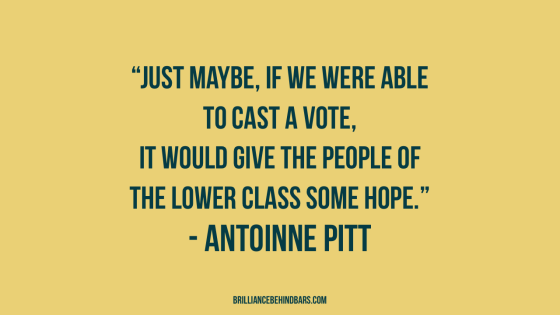
Just maybe, if we were able to cast a vote,
It would give the people of the lower class some hope.
Just maybe…

My name is Antoinne Pitt, I am from Portsmouth, Virginia, currently incarcerated at Lawrenceville Correctional Center. I am the author of Thinking With A Purpose, which is a curriculum created to reduce the rate of recidivism and prevent criminal thinking and influences and the author of C.O.A.T (Countering Overdoses and Addiction Treatment) a curriculum created to combat the opioid epidemic that has plagued our nation. You can contact my publisher, Winter Giovanni, for additional information or go to www.infinitypublicationsllc.net to see my bio. You can also support my fight for freedom by signing my change.org petition, or writing a support letter to: the Secretary Of Commonwealth, P.O. Box 2454 Richmond, VA 23218- 2454.

Peace and Blessings.

Prompt: The Incarcerated Vote

HR 1 is a voting rights bill that if it was passed in its original form, would have restored the rights of incarcerated people and ex-felons to vote in federal elections. The bill has long been amended solely to restoring the voting rights of ex-felons, but it also brought attention to another intriguing aspect I’m sure most people probably don’t know.

For centuries at the behest of the white establishment, minorities have been disproportionately policed, jailed, and imprisoned. Beyond stripping the lives away from young black and brown men in this country, states have found ways to actually profit from putting minorities in prison economically evidently, but more interesting, politically.

HR 1 identifies a law that allows counties with prisons to have people they house counted toward that county’s population on the U.S. census. Thereby pilfering the population of multicultural, urban (largely Democratic) areas and adding them to rural, largely white (largely Republican) areas. All the while, eviscerating the incarcerated person’s right to vote. This dynamic is the core of what can be considered as politically-motivated slavery.

With the reallocation of the urban populace to these rural areas, the voice of the people is stricken from a more accurate representation of the people, and is instead granted to a more diluted form of constituents who would be more likely in favor of continuing the trend of mass incarceration, post-millennium slavery, and the further exploition of black and brown people for personal and monetary gain.

HR 1 intends to correct that law and return the population of those incarcerated back to their hometowns… There has been much work in recent legislation concerning criminal justice reform to correct the racist systemic devices that have been used to disenfranchise droves of minorities in America for a majority of its history, however the threat of the old establishment looms over us all, impeding our progression to a more perfect union. Awareness is the first step, activism is the following one.

Know that the bile of racism runs deep, and its effects are subtle. The old guard feared that we, as a people, would become aware, so they withheld education and knowledge from us for centuries. But what they fear most is that, armed with such education and knowledge of self, we would actually do something about it, so they try to break and discourage us, and even pit us against one another. We must understand that we are solely responsible for making sure that their every effort from here on out is made in vain. Times ARE changing. We, at this moment, may not be able to enjoy a world truly free of systemic racism before our time is up, but be sure, our efforts now will be the catalyst for the world our future generations will experience…

I extend my love to each and everyone seeking freedom, not only for themselves, but the world now and the world to come…

Love, peace, and action…
-Q.

Prompt For Incarcerated People: Compose an essay, poem, art, or any other form of creative expression you may have. Think about your experience participating and learning about the political process. Below is a list of questions meant to serve as inspiration for your piece.

  • What is your experience with voting and the political system before and after incarceration?
  • What are your thoughts on voting while incarcerated?
  • How can we change the point of view on letting incarcerated people vote?
  • How has participating in the political system impacted your life?
  • Are you more educated about the system now than you were back then?
  • How would being able to vote change your life?

Make sure to let the people know who you are, where you’re from, and any project(s) you may have or have been involved with so we can promote it. Thank you for your contribution. We are working together to bring awareness to the brilliance they have locked away behind bars.

Thank you to the readers of BrillianceBehindBars.com. Answers to this prompt will be coming in through April of 2021 from those incarcerated across Virginia.